November 21, 2005

John Davenant’s (1572–1641) Sufficiency Distinctions

(UPDATE on 8-21-07: Some of John Davenant’s writings can be found online for free HERE).
CHAPTER IV.

THE SECOND PROPOSITION STATED, EXPLAINED AND CONFIRMED


IN our first proposition we endeavored to shew that the death or merit of Christ was appointed by God, proposed in the holy Scriptures, and to be considered by us, as an universal remedy applicable to all men for salvation from the ordination of God. And on this account we hesitate not to assert that Christ died for all men, inasmuch as he endured death, by the merit and virtue of which all men individually who obey the Gospel may be delivered from death and obtain eternal salvation. But because some persons in such a way concede that Christ died for all men, that with the same breath they assert that he died for the elect alone, and so expound that received distinction of Divines, That he died for all sufficiently, but for the elect effectually, that they entirely extinguish the first part of the sentence; we will lay down a second proposition, which will afford an occasion of discussing that subject expressly, which we have hitherto only glanced at slightly by the way. This second proposition, therefore, shall be reduced into this form; if it is rather prolix, pardon it. The death of Christ is the universal cause of the salvation of mankind, and Christ himself is acknowledged to have died for all men sufficiently, not by reason of the mere sufficiency or of the intrinsic value, according to which the death of God is a price more than sufficient for redeeming a thousand worlds; but by reason of the Evangelical covenant confirmed with the whole human race through the merit of his death, and of the Divine ordination depending upon it, according to which, under the possible condition of faith, remission of sins and eternal life is decreed to be set before every mortal man who will believe it, on account of the merits of Christ. In handling this proposition we shall do two things. First, we shall explain some of the terms. Secondly, we shall divide our proposition into certain parts, and establish them separately by some arguments.

In the first place, therefore, is to be explained, what we mean by mere sufficiency, and what by that which is commonly admitted by Divines, That Christ died for all sufficiently. If we speak of the price of redemption, that ransom is to be acknowledged sufficient which exactly answers to the debt of the captive; or which satisfies the demand of him who has the power of liberating the captive. The equality of one thing to another, or to the demands of him who has power over the captive, constitutes what we call this mere sufficiency. This shall be illustrated by examples. Suppose my brother was detained in prison for a debt of a thousand pounds. If I have in my possession so many pounds, I can truly affirm that this money is sufficient to pay the debt of my brother, and to free him from it. But while it is not offered for him, the mere sufficiency of the thing is understood, and estimated only from the value of it, the act of offering that ransom being wanting, without which the aforesaid sufficiency effects nothing. For the same reason, if many persons should be capitally condemned for the crime of high treason, and the king himself against whom this crime was committed should agree that he would be reconciled to all for whom his son should think fit to suffer death: Now the death of the Son, according to the agreement, is appointed to be a sufficient ransom for redeeming all those for whom it should be offered. But if there should be any for whom that ransom should not be offered, as to those it has only a mere sufficiency, which is supposed from the value of the thing considered in itself, and not that which is understood from the act of offering. To these things I add, If we admit the aforesaid ransom not only to be sufficient from the equality of the one thing to the other, and from his demand, who requires nothing more from the redemption of the captives; but also to be greater and better in an indefinite degree, and to exceed all their debts, yet if there should not be added to this the intention and act of offering for certain captives, although such a ransom should be ever so copious and superabundant, considered in itself and from its intrinsic value, yet what was said of the sufficiency may be said of the superabundance, that there was a mere superabundance of the thing, but that it effected nothing as yet for the liberation of the persons aforesaid.

Now to this mere sufficiency, which regards nothing else than the equal or superabundant worth of the appointed price of redemption, I oppose another, which, for the sake of perspecuity, I shall call ordained sufficiency. This is understood when the thing which has respect to the ransom, or redemption price, is not only equivalent to, or superior in value to the thing redeemed, but also is ordained for its redemption by some wish to offer or actual offering. Thus a thousand talents laid up in the treasury of a prince are said to be a sufficient ransom to redeem ten citizens taken captive by an enemy; but if there is not an intention to offer, and an actual offering and giving these talents for those captives, or for some of them, then a mere and not an ordained sufficiency of the thing is supposed as to those person for whom it is not given. But if you add the act and intention offering them for the liberation of certain persons, then the ordained sufficiency is asserted as to them alone. Further, this ordained sufficiency of the ransom for the redemption of a captive may be twofold: Absolute; when there is such agreement between him who gives and him who receives this price of redemption for the liberation of the captives, that as soon as the price is paid, on the act of payment the captives are immediately delivered. Conditional; when the price is accepted, not that it may be paid immediately, and the captive be restored to liberty; but that he should be delivered under a condition if he should first do something or other. When we say that Christ died sufficiently for all, we do not understand the mere sufficiency of the thing with a defect of the oblation as to the greater part of mankind, but that ordained sufficiency, which has the intent and act of offering joined to it, and that for all; but with the conditional, and not the absolute ordination which we have expressed. In one word, when we affirm that Christ died for all sufficiently, we mean, That there was in the sacrifice itself a sufficiency or equivalency, yea, a superabundance of price or dignity, if it should be compared to the whole human race; that both in the offering and the accepting there was a kind of ordination, according to which the aforesaid sacrifice was offered and accepted for the redemption of all mankind. This may suffice for the explanation of the first term.
John Davenant, “A Dissertation on the Death of Christ,” in An Exposition of the Epistle of St. Paul to the Colossians, trans. Josiah Allport, 2 vols. (London: Hamilton, Adams, and Co., 1832), 2:401–404.

My remarks:

Davenant begins by showing that he wants to refute the strict particularist view (as over against Davenant's dualistic view) of some who, in the "same breath," say that Christ died in some sense for all men, but then hold that he died for the elect alone. They give lip service to the sufficiency/efficiency formula of the schoolmen or "Divines", but mean something different by it. Davenant addresses this issue by distinguishing between a "mere sufficiency" and an "ordained sufficiency." First, a "mere sufficiency," according to Davenant's categories, is unrelated to intention and active principles of actual giving and offering. That's crucial to note. A thousand pounds may have intrinsic worth or sufficiency to free a given prisoner, but if it is not given or offered to him, then it is "merely sufficient." Two thousand pounds may be of superabundant sufficiency, intrinsically considered, for the payment, but if it is not offered then it is merely sufficient for that prisoner. As over against this mere sufficiency, there is the sense of an ordained sufficiency. This sense of sufficiency is related to intention and offering. As Davenant says, "This is understood when the thing which has respect to the ransom, or redemption price, is not only equivalent to, or superior in value to the thing redeemed, but also is ordained for its redemption by some wish to offer or actual offering." Equivalent intrinsic worth (whether a moral or pecuniary equivalency) is joined to an intention and active giving or offering with the sense of an "ordained sufficiency."

Also, within the sense of an ordained sufficiency, he makes the twofold distinction between an "absolute" and a "conditional" agreement. With an absolute sort of agreement, "as soon as the price is paid, on the act of payment the captives are immediately delivered." An absolute payment ipso facto liberates, as Charles Hodge puts it, the recipients when the payment is made. In a conditional agreement, the captive is restored to liberty after he or she first does something. There are terms or conditions that must be met, even though the payment has already been made. Davenant would argue that the condition for being liberated or saved unto eternal life is faith. Even though Christ has made a morally equivalent "payment" in dying a death that every sinner deserves, no one is, on that basis alone, saved. Even though Davenant uses terms such as "payment," "price," "purchase" etc., he is not making Christ's death a literal pecuniary or commercial payment. He is speaking analogically or metaphorically. There is a valid comparison between the paying of a moral debt and the paying of a commercial debt (the scriptures liken these things metaphorically), but the language should not be made univocal so as to discount a measure of discontinuity in the comparison. As Dabney says regarding some analogies he makes, "None will deny that the discussion of God's nature and activities should be approached with profound reverence and diffidence. One of the clearest declarations concerning him in the Scriptures is, that we may not expect to "find out the Almighty unto perfection" [(Job 11:7)]. Should a theologian assume, then, that his rationale of God's actings furnished an exhaustive or complete explanation of them all, this alone would convict him of error. It must be admitted, also, that no analogy can be perfect between the actions of a finite and the infinite intelligence and will. But analogies may be instructive and valuable which are not perfect; if they are just in part, they may guide us in the particulars wherein there is a true correspondence. And the Scriptures, which do undertake to unfold "parts of his ways" [(Job 26:14)]], will be safe guides to those who study them with humility."

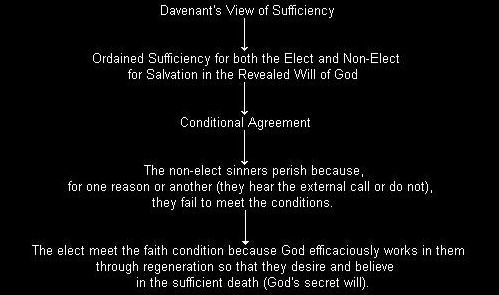
The position of John Davenant is that Christ paid a morally equivalent price for the redemption of all mankind intentionally, but the reception of the benefits unto eternal life are based in conditions; such as, "he who believes shall not perish, but he who does not believe shall perish." Belief in Christ is the necessary condition for the enjoyment of eternal life, but none will perform this condition except the elect, for God grants to them alone the moral ability to believe as a result of his eternal decree or predestination. This sets Davenant's view apart from Arminianism as well. We might illustrate Davenant's position in the following way:
November 19, 2005

Chesterton on Courage

Rush Limbaugh recently quoted from G. K. Chesterton's book on Orthodoxy. He brought it up on Veterans' Day because it's an exposition on the idea of courage. It is a remarkable piece of writing that is worthy of our meditation. Chesterton says:
"Paganism declared that virtue was in a balance; Christianity declared it was in a conflict: the collision of two passions apparently opposite. Of course they were not really inconsistent; but they were such that it was hard to hold simultaneously. Let us follow for a moment the clue of the martyr and the suicide; and take the case of courage. No quality has ever so much addled the brains and tangled the definitions of merely rational sages. Courage is almost a contradiction in terms. It means a strong desire to live taking the form of a readiness to die. “He that will lose his life, the same shall save it,” is not a piece of mysticism for saints and heroes. It is a piece of everyday advice for sailors or mountaineers. It might be printed in an Alpine guide or a drill book. This paradox is the whole principle of courage; even of quite earthly or quite brutal courage. A man cut off by the sea may save his life if he will risk it on the precipice.

He can only get away from death by continually stepping within an inch of it. A soldier surrounded by enemies, if he is to cut his way out, needs to combine a strong desire for living with a strange carelessness about dying. He must not merely cling to life, for then he will be a coward, and will not escape. He must not merely wait for death, for then he will be a suicide, and will not escape. He must seek his life in a spirit of furious indifference to it; he must desire life like water and yet drink death like wine. No philosopher, I fancy, has ever expressed this romantic riddle with adequate lucidity, and I certainly have not done so. But Christianity has done more: it has marked the limits of it in the awful graves of the suicide and the hero, showing the distance between him who dies for the sake of living and him who dies for the sake of dying. And it has held up ever since above the European lances the banner of the mystery of chivalry: the Christian courage, which is a disdain of death; not the Chinese courage, which is a disdain of life."

November 17, 2005

Reply to Laura


- Tony, you are free to point out any perceived holes in this, but I had an out-of-the-blue realization pro limited atonement: If the question is what Christ's death was meant to accomplish, the propitiation of God's wrath is certainly part of the answer. If Christ died for all sinners, the fact that the non-elect are called "vessels of wrath" (Rom. 9) who are storing up God's wrath in their present rebellion seems to mean that Christ's death did not satisfy God's wrath for those who are bound for eternal punishment. How could we still say, then, that Christ died for the sins of "the world" in the sense of "every individual" and not "elect from all nations?"

My reply:

Hi Laura,

I'm glad to see that you are spending some time thinking about the extent and intent of Christ's death :-) It's a profound subject that relates to so many areas of theology. It provides a good opportunity to test the virtue of our thinking processes. For that reason (among many others), my "meditations" frequently touch on the issue. With that said, let me make a few points:

1) The term "limited atonement" is an imprecise way to refer to the debated issue of the nature and intent of Christ's death, even as the other TULIP words tend to be. If the doctrine is put in contrast to the Arminian view, then it's really just a doctrine that defends the logical outworking of God's special decree concerning the elect. The "limit" word refers to Christ's intent in coming to die, i.e. it was for his elect ones. Some Calvinists think that intent was exclusively for the elect alone (the strictly limited view), while others sees additional motives concerning all of lost humanity (the moderate view). The expression "limited atonement" should not merely be associated with the strict view. Even the moderate Calvininsts, like myself, Charles Hodge, R. L. Dabney and Shedd, maintain that there is a special design/purpose/intent in Christ's coming to die in the case of the elect. Some push the limitation idea into the very nature (not merely the intent) of Christ's death by commercial or pecuniary debt payment notions, i.e. he literally purchases things for the elect alone. Moderate Calvinists say the limitation is only in the special decree to effectually apply the death (which death, intrinsically considered, is unlimited in terms of it's legal accomplishment - he suffers or bears the full curse of all that the law requires of any given sinner) to the elect alone by the Spirit through the instrumentality of faith.

The positions on the intent issue are not merely between 1) an exclusive or singular intent to come and die for the elect alone (the strictly limited view) and 2) a singular and equal intent (same motive for every lost person) to die for every one (Arminianism); but there is, at least, a third view: 3) Christ came to die for all (general motive), but especially for the elect (special motive). This third view is related to the issue of God's love. He loves all mankind, but especially his elect (his bride). It's a false dilemma to posit either that God only loves the elect or he loves all equally, just as it is a false dilemma to posit that either Christ died only for the elect, or he died with an equal intent for all. I assume that you are not positing these dilemmas, but I am just addressing this issue in case you see it elsewhere.

2) With regard to the issue of propitiation, Christ certainly came to satisfy God's wrath against sinners. However, as the scriptures say, we come to be at peace with God at the point of conversion or faith. Prior to that, we are children of wrath, even as the rest, as Paul says in his letter to the Ephesians. So then, God was propitiated in the case of Laura when she believed. Prior to that, Christ was the provisional means by which God could be propitiated towards Laura, but you abided under his wrath until the point of faith, or real union with Christ. Propitiation is scripturally associated with forgiveness of sins, restored peaceful relations, and justification. If we push the doctrines about what occurs at the point of real union (our actual union through faith) with Christ back into the point of our federal union (our decretal union with Christ prior to our existence), then we virtually arrive at our justification at the time of the cross, or in eternity (two versions of theoretical antinomianism). This undermines our responsibility to believe in order to be justified (what some in the past called "duty-faith"), as well as the doctrine that elect sinners are under God's wrath prior to faith.

Even though Christ died especially for Laura as an elect sinner, the benefits of what he did in her case were suspended until she performed the decreed condition for the reception of his merits, namely faith or trust in Christ alone (which Laura was only able to perform because the Holy Spirit, through regenerating power in her heart, granted her the moral ability to do so - contra Arminianism). Had Laura not performed this necessary condition, then she would have remained under God's wrath.

3) You ask, "If Christ died for all sinners, the fact that the non-elect are called "vessels of wrath" (Rom. 9) who are storing up God's wrath in their present rebellion seems to mean that Christ's death did not satisfy God's wrath for those who are bound for eternal punishment. How could we still say, then, that Christ died for the sins of "the world" in the sense of "every individual" and not "elect from all nations?"

The reason why Christ's death does not atone for these "vessels of wrath" is because they remain in unbelief. They fail, for one reason or another, to appropriate the remedy. They do not look to the lifted up serpent with the eyes of faith to heal the bite of sin (John 3:14-17). Christ satisfies for all that the law requires, but it does not avail anyone who remains in unbelief, therefore Calvin says, "And the first thing to be attended to is, that so long as we are without Christ and separated from him, nothing which he suffered and did for the salvation of the human race is of the least benefit to us." In Calvin's way of putting it, Christ can die for the sins of the "human race" or "the world", but it does not follow that they are ipso facto liberated. One must be really united to him (i.e. not "seperated" or "without Christ" as Calvin expresses it) through faith to receive the benefits.

4) Incidently, nowhere in scripture does "world" or kosmos mean "the elect from all nations." The "world", biblically, refers to sinful and darkened humanity in organized hostility to God, or to the sphere or location in which these sinners dwell. Even when the "world" in scripture means the location of sinners ("Christ came into the world" etc.), it still carries the association with the first sense, i.e. to sinful humanity. "World" has morally dark connotations. It's put in contrast to the "light."

Those inclined to see "world" as meaning the "elect from all nations" are taking high Calvinist interpretations. The people who usually take this view are picking it up from recent "Calvinistic" (actually not from Calvin) literature steeped in Owenic and Post-Reformational scholastic categories (like G. Clark, Sproul, White, etc). Some even get it from Arthur Pink, one who was, at least when he wrote his book The Sovereignty of God, influenced by John Gill (a hyper-Calvinist who denied free offers and duty-faith [Pink accepted "duty-faith"]).

What I am saying is that taking the "world" as entailing "the elect" is a high (although not necessarily hyper) Calvinist path. One does not have to take that method of interpretation to remain a solid, historic Calvinist in harmony with the Synod of Dort. The Calvinists who say that there is a sense in which Christ died for the whole world are not necessarily "4 point" Calvinists. They may be 6 point Calvinists. They wish to add a point of clarification, namely that Christ really or actually suffered sufficiently for all mankind (it's no mere hypothetical sufficiency "had God so intended", contra Owen), in addition to the teaching or truth that he died especially for the elect (contra Arminianism).

5) I've been meaning to post a blog on the issue of either "all without exception" vs. "all without distinction" for awile now, but have not done so yet. This issue is related to the "world" interpretation you mention above. There are logical leaps that ofter go undetected. I will try to address this issue as soon as possible, because it is related to high Calvinistic hermeneutics. It's hard to find Calvinistic critiques of high Calvinistic interpretive methods and theology. In some ways, my blog is a collection of some of my efforts to deconstruct their thinking patterns, and analyze them biblically and systematically (I am a different kind of Calvinistic Gadfly). We are attempting do this same thing at the Calvin and Calvinism list, as you know. We have addressed the "all without exception" vs. "all without distinction" topic there, but I need to post something on my blog about it. I will do so asap, because it is related to the "world" means "elect" subject.

I hope that all of the above helps to clarify your thinking on the issues, even if you end up disagreeing. These subjects are worthy of constant and serious contemplation/meditation. I also hope that things I have said in this post encourage you to reflect and think critically about your own theological presuppositions. Becoming epistemologically self-aware, as you know, is an aspect of becoming intellectually virtuous :-)

In him,
Tony

Other Helpful and Related Posts:


November 16, 2005

John Davenant's (1572–1641) Reply to the Double Jeopardy Issue

(UPDATE on 8-21-07: Some of John Davenant's writings can be found online for free HERE).
Objection 5. If the death of Christ be a benefit from the ordination of God, applicable to each and every man, then it may be said, that Christ made satisfaction for the sins of the whole human race. But this cannot be defended, without at the same time overthrowing the justice of God, since the idea of justice does not admit that the same sin should be punished twice. Suppose, then, that the death of Christ is a ransom, by which satisfaction was made to God for the sins of the human race, how can so many persons be called to account for the same by the justice of God, and be tormented with eternal punishment?

Reply 5. As to the major proposition, we think its consequence may be safely conceded. For the orthodox Fathers boldly assert that Christ made satisfaction for the sins of the human race or all of mankind. Thus Eusebius, (Evang. Demonstr. lib. x. in the preface) It was needful that the Lamb of God should be offered as a sacrifice for the other lambs whose nature he assumed, even for the whole human race. Thus Nazianzen (Orat. 2. in Pasch.) The sacrifice of Christ is an imperishable expiation of the whole world. Thus, finally (omitting others), Cyril (Catech. 13.), He redeemed the whole world of mankind. The same form of speaking is every where made use of in the Articles of religion of our Church of England, (Art. 2, 15, 31, &c.). Thus also those speak who endeavour to limit to the utmost this death of Christ. We adduced before the testimony of the Reverend Heidelberg Divine Pareus, who freely confesses in his judgment exhibited at the Synod of Dort, The cause and matter of the passion of Christ was a feeling or sustaining of the wrath of God, incensed by the sin, not of some men, but of the whole human race. A little afterwards, The whole of sin and of the wrath of God against it, is affirmed to have been borne by Christ. Nor ought this to appear unsound, since this universal redemption, satisfaction, or expiation performed by the death of Christ, brings nothing more than an universal cause of salvation to be confirmed and granted to the human race by the Divine ordination; the benefit of which every individual may enjoy through faith required by the Gospel. We therefore call Christ the Redeemer of the world, and teach that he made satisfaction for the sins not of some, but of the whole world, not because that on account of the payment of this price for the sins of the human race, all mankind individually are to be immediately delivered from captivity and death, but because by virtue of the payment of this price, all men individually may and ought to be delivered from death, and, in fact, are to be delivered according to the tenor of the evangelical covenant, that is, if they repent and believe in this Redeemer.

To what is further urged, That it is contrary to justice to receive satisfaction or a ransom for the sins of the whole human race, and yet not to deliver them all from the punishment of their sins, but, notwithstanding this satisfaction, to adjudge many to eternal torments; I answer, That this would indeed be most unjust, if we ourselves had paid this price to God, or if our Surety, Jesus Christ, had so offered to God his blood as a satisfactory price, that without any other intervening condition, all men should be immediately absolved through the offering of the oblation made by him; or, finally, if God himself had covenanted with Christ when he died, that he would give faith to every individual, and all those other things which regard the infallible application of this sacrifice which was offered up for the human race. But since God himself of his own accord provided that this price should be paid to himself, it was in his own power to annex conditions, which being performed, this death should be advantageous to any man, not being performed it should not profit any man. Therefore no injustice is done to those persons who are punished by God after the ransom was accepted for the sins of the human race, because they offered nothing to God as a satisfaction for their sins, nor performed that condition, without the performance of which God willed not that this satisfactory price should benefit any individual. Nor, moreover, ought this to be thought an injustice to Christ the Mediator. For he so was willing to die for all, and to pay to the Father the price of redemption for all, that at the same time he willed not that every individual in any way whatsoever, but that all, as soon as they believed in him, should be absolved from the guilt of their sins. Lastly, Christ, in offering himself in sacrifice to God the Father in order to expiate the sins of the world, nevertheless submitted to the good pleasure of the Father the free distribution and application of his merits, neither was any agreement entered into between the Father and the Son, by which God is bound to effect that this death of Christ, which, from the ordination of God, is applicable to all under the condition of faith, should become applied to all by the gift of faith. We ought not, therefore, to deny that the offering of Christ once made is a perfect satisfaction for the sins, not of some men only, but of all; yet so that he who is simply said to have died for all, promises remission of sin through his death and salvation conditionally, and will perform it to those alone who believe. We will illustrate all these things by a similitude; Suppose that a number of men were cast into prison by a certain King on account of a great debt, or that they were condemned to suffer death for high treason; but that the King himself procured that his own Son should discharge this debt to the last farthing; or should substitute himself as guilty in the room of those traitors, and should suffer the punishment due to them all, this condition being at the same time promulgated both by the King and his Son, That none should be absolved or liberated except those only who should acknowledge the King's Son for their Lord and serve him: These things being so determined, I inquire, if those who persist in disobedience and rebellion against the King's Son should not be delivered, would any charge of injustice be incurred, because after this ransom had been paid, their own debts should be exacted from many, or after the punishment endured by the Son, these rebels should nevertheless be punished? By no means; because the payment of the just price, and the enduring of the punishment was ordained to procure remission for every one under the condition of obedience, and not otherwise. I shall add no more; it will be easy to accommodate all these things to our present purpose.
John Davenant, “A Dissertation on the Death of Christ,” in An Exposition of the Epistle of St. Paul to the Colossians (London: Hamilton, Adams, and Co., 1832), 2:374–377.

For other responses to the Double Jeopardy argument by Reformed thinkers such as Edward Polhill, Charles Hodge, R. L. Dabney, W. G. T. Shedd, Curt Daniel and Neil Chambers, go here:

Double Jeopardy?

November 15, 2005

Media, Music and the Meaning of Life

The MacLaurin Institute has an excellent audio lecture (among many others) by Ken Myers entitled Media, Music and the Meaning of Life. If you would like to hear an insightful analysis on the sociology of music from a Christian perspective, then be sure to listen to this talk by Myers.


CLICK HERE (it's near the middle of the page)

November 9, 2005

More for the Audiophiles

Veritas Media has an excellent collection of audio lectures by outstanding scholars. Be sure to check it out.

November 2, 2005

Mohler/Patterson Debate

If you have not seen this news yet, Tom Ascol of Founders Ministries has reported that Al Mohler will be debating Paige Patterson on the issue of Calvinism. Read about it HERE.

More information and comments by Ascol are HERE.

Dabney in Audio

I recently put Robert Lewis Dabney's article God's Indiscriminate Proposals of Mercy, As Related to His Power, Wisdom, and Sincerity into audio form. This is one of the most remarkable theological writings I have ever read. Dabney incorporates many areas of his sound theology to bear on his subject.

This (my) audio reading may be freely distributed.

Download Version (29.4 MB) It is here as well.


Thanks to Ryan at Reformed Audio for posting it on his site.

Added at 5:40 am:

Well, I have just listened to some of the reading and hear some mistakes that I should have spotted earlier. I will try to correct the audio to accurately reflect Dabney's article. Be sure to follow what Dabney says in his text. The errors I have heard so far in my reading are minor.