
Truth does not consist in minute accuracy of detail, but in conveying a right impression; and there are vague ways of speaking that are truer than strict facts would be. When the Psalmist said, ‘Rivers of water run down mine eyes, because men keep not thy law,’ he did not state the fact, but he stated a truth deeper than fact, a truer.—Henry Alford
Showing posts with label Uncategorized. Show all posts
Showing posts with label Uncategorized. Show all posts
October 27, 2010
Truth and Poetic Language
August 27, 2010
On Obama and A Popular False Either/Or Dilemma
To posit that EITHER 1) Obama is a Muslim OR 2) Obama is a Christian is a false either/or dilemma since there is a tertium quid; namely, the option that 3) Obama is sincere in his profession to be a Christian but sincerely wrong about that, which is actually the case with millions of Americans to varying degrees.
While the consideration of the third option may offend some people, they should rather take this constructively as an opportunity to examine themselves by Apostolic standards for a change (2 Cor. 13:5).
November 14, 2009
Dictionary of National Biography
Eventually I will search these volumes for terms such as "non-conformist," "puritan," "divine," "dissenting," and "reformer" in order to find more obscure names of Calvinistic theologians. I will also be using this for some biographical entries of men that I have posted. You can read about this reference work here, or find a person in the Oxford Biography Index here. The Online Books Page has a complete index here.
Volume 1: Abbadie—Anne (Archive, Google)
Volume 2: Annesley—Baird (Archive, Google)
Volume 3: Baker—Beadon (Archive, Google)
Volume 4: Beal—Biber (Archive, Google)
Volume 5: Bicheno—Bottisham (Archive, Google)
Volume 6: Bottomley—Browell (Archive, Google)
Volume 7: Brown—Burthogge (Archive, Google)
Volume 8: Burton—Cantwell (Archive, Google)
Volume 9: Canute—Chaloner (Archive, Google)
Volume 10: Chamber—Clarkson (Archive, Google)
Volume 11: Clater—Condell (Archive, Google)
Volume 12: Conder—Craigie (Archive, Google)
Volume 13: Craik—Damer (Archive, Google)
Volume 14: Damon—D'Eyncourt (Archive, Google)
Volume 15: Diamond—Drake (Archive, Google)
Volume 16: Drant—Edridge (Archive, Google)
Volume 17: Edward—Erskine (Archive, Google)
Volume 18: Esdaile—Finan (Archive, Google)
Volume 19: Finch—Forman (Archive, Google)
Volume 20: Forrest—Garner (Archive, Google)
Volume 21: Garnett—Gloucester (Archive, Google)
Volume 22: Glover—Gravet (Archive, Google)
Volume 23: Gray—Haighton (Archive, Google)
Volume 24: Hailes—Harriott (Archive, Google)
Volume 25: Harris—Henry I (Archive, Google)
Volume 26: Henry II—Hindley (Archive, Google)
Volume 27: Hindmarsh—Hovenden (Archive, Google)
Volume 28: Howard—Inglethorp (Archive, Google)
Volume 29: Inglis—John (Archive, Google)
Volume 30: Johnes—Kenneth (Archive, Google)
Volume 31: Kennett—Lambart (Archive, Google)
Volume 32: Lambe—Leigh (Archive, Google)
Volume 33: Leighton—Lluelyn (Archive, Google)
Volume 34: Llwyd—Maccartney (Archive, Google)
Volume 35: MacCarwell—Maltby (Archive, Google)
Volume 36: Malthus—Mason (Archive, Google)
Volume 37: Masquerier—Millyng (Archive, Google)
Volume 38: Milman—More (Archive, Google)
Volume 39: Morehead—Myles (Archive, Google)
Volume 40: Myllar—Nicholls (Archive, Google)
Volume 41: Nichols—O'Dugan (Archive, Google)
Volume 42: O'Duinn—Owen (Archive, Google)
Volume 43: Owens—Passelewe (Archive, Google)
Volume 44: Paston—Percy (Archive, Google)
Volume 45: Pereira—Pockrich (Archive, Google)
Volume 46: Pocock—Puckering (Archive, Google)
Volume 47: Puckle—Reidfurd (Archive, Google)
Volume 48: Reilly—Robins (Archive, Google)
Volume 49: Robinson—Russell (Archive, Google)
Volume 50: Russen—Scobell (Archive, Google)
Volume 51: Scoffin—Sheares (Archive, Google)
Volume 52: Shearman—Smirke (Archive, Google)
Volume 53: Smith—Stanger (Archive, Google)
Volume 54: Stanhope—Stovin (Archive, Google)
Volume 55: Stow—Taylor (Archive, Google)
Volume 56: Teach—Tollet (Archive, Google)
Volume 57: Tom—Tytler (Archive, Google)
Volume 58: Ubaldini—Wakefield (Archive, Google)
Volume 59: Wakeman—Watkins (Archive, Google)
Volume 60: Watson—Whewell (Archive, Google)
Volume 61: Whichcord—Williams (Archive, Google)
Volume 62: Williamson—Wordon (Archive, Google)
Volume 63: Wordsworth—Zuylestein (Archive, Google)
Supplement:
Volume 1: Abbott—Childers (Archive, Google)
Volume 2: Chippendale—Hoste (Archive, Google)
Volume 3: How—Woodward (Archive, Google)
Errata (Archive, Google)
Index and Epitome: (Archive, Google, Google 2nd edition)
November 21, 2007
Reflections on Anti-Labelism
 "Once you label me, you negate me." -- Soren Kierkegaard
If you have engaged in theological dialogue and debate at all, you have no doubt encountered the person who says, "I don't like labels." You might also, if you're anything like me, immediately view that person as suspect. Frequently it's the case that such a person wants to hide or evade some point of argumentation from Scripture or history. If their view was correctly identified (labeled), their error might be discovered and successfully refuted, so they dodge labeling altogether, even while hypocritically using labels for others themselves. For that reason, I sometimes label those who say they don't like labels as "anti-labelites." This type of person is like a slippery, postmodern eel that doesn't want to be pinned down on any point.
However, not everyone who objects to labels is that type. One might have legitimate concerns and cautions about labels since they can be used to unfairly smear people and/or their beliefs.
For instance, consider the label "catabaptist." Credobaptists in the past have been labeled as "catabaptists," as if they were averse to baptism. Actually, they simply do not consider the water sprinkling of an infant to be "baptism." Disagree with credobaptists if you will, but it is blatantly unfair to call them "catabaptists," or even "anabaptists" [re-baptizers]. The "anabaptist" label begs the question, or assumes that sprinkling an infant constitutes a legitimate baptism. Remember, my point here concerns accuracy and fairness in labeling, and not whether or not paedobaptism is true or false. What I said above just serves to illustrate the point of unfair labeling. One should not expect a credobaptist to call themselves an "anabaptist" or a "catabaptist." It both assumes the legitimacy of paedobaptism and serves to smear the credo, as if they are averse to baptism.
Many more examples could be used to illustrate the point of unfair labeling.
One should be careful when using labels to describe those who differ. We should be concerned about historical accuracy and with using objective descriptions. I think it is good to strive to use descriptive labels that even one’s opponents can accept. I am not saying that we should be slaves to their label preferences either. Sometimes they may prefer a label that is actually misleading and/or deceptive. We can and should avoid those. I think we can strive for objectivity in labeling if both parties acknowledge their bias and seek to understand one another. Or, even if our opponent does not wish to acknowledge their bias, we should make an effort to so understand their position that we can accurately and objectively define or label it in such a way that, if they were reasonable, they themselves would accept the terms. If we refuse to be objective in this way, but rather use smear terms and labels, then it is no surprise that more anti-labelites are produced. We become part of the problem rather than part of the solution.
June 12, 2007
How To Hyper-Link
These instructions are for those in the blogosphere who keep forgetting how to create hyper-links to their blog posts (you know who you are). So, for the sake of that forgetful Australian, here are some directions for him to bookmark.
HTML uses the < > (anchor) tag to create a link to another document.
An anchor can point to any resource on the Web: an HTML page, an image, a sound file, a movie, etc.
The syntax of creating an anchor:
The < > tag is used to create an anchor to link from, the href attribute is used to address the document to link to, and the words between the open and close of the anchor tag will be displayed as a hyperlink.
This anchor defines a link to my blog:
The line above will look like this in a browser:
These instructions will work when you are commenting on someone else's blog and want to leave a link for those who wish to do further research.


January 15, 2007
A. T. Robertson and Diotrephes
NKJ 3 John 1:9 I wrote to the church, but Diotrephes, who loves to have the preeminence among them, does not receive us. 10 Therefore, if I come, I will call to mind his deeds which he does, prating against us with malicious words. And not content with that, he himself does not receive the brethren, and forbids those who wish to, putting them out of the church.
A. T. Robertson, in his Word Pictures in the New Testament, reports that:
I thought this was funny. A. T. Robertson just exegeted the text and didn't name anyone. As a result, 25 deacons felt personally attacked and cancelled their subscriptions to the paper.
A. T. Robertson, in his Word Pictures in the New Testament, reports that:
Some forty years ago I wrote an article on Diotrephes for a denominational paper. The editor told me that twenty-five deacons stopped the paper to show their resentment against being personally attacked in the paper.A. T. Robertson, Word Pictures in the New Testament, 6 vol. (Grand Rapids: Baker, 1933), 6:263.
I thought this was funny. A. T. Robertson just exegeted the text and didn't name anyone. As a result, 25 deacons felt personally attacked and cancelled their subscriptions to the paper.
December 14, 2005
Alvin Plantiga’s Humorous View on Fundamentalism
We must first look into the use of this term “fundamentalist.” On the most common contemporary academic use of the term, it is a term of abuse or disapprobation, rather like “son of a bitch,” more exactly “sonovabitch,” or perhaps still more exactly (at least according to those authorities who look to the Old West as normative on matters of pronunciation) “sumbitch.” When the term is used in this way, no definition of it is ordinarily given. (If you called someone a sumbitch, would you feel obliged first to define the term?) Still, there is a bit more to the meaning of “fundamentalist” (in this widely current use): it isn’t simply a term of abuse. In addition to its emotive force, it does have some cognitive content, and ordinarily denotes relatively conservative theological views. That makes it more like “stupid sumbitch” (or maybe “fascist sumbitch”?) than “sumbitch” simpliciter. It isn’t exactly like that term either, however, because its cognitive content can expand and contract on demand; its content seems to depend on who is using it. In the mouths of certain liberal theologians, for example, it tends to denote any who accept traditional Christianity, including Augustine, Aquinas, Luther, Calvin, and Barth; in the mouths of devout secularists like Richard Dawkins or Daniel Dennett, it tends to denote anyone who believes there is such a person as God. The explanation is that the term has a certain indexical element: its cognitive content is given by the phrase “considerably to the right, theologically speaking, of me and my enlightened friends.” The full meaning of the term, therefore (in this use), can be given by something like “stupid sumbitch whose theological opinions are considerably to the right of mine.”Alvin Plantinga, Warranted Christian Belief (New York: Oxford University Press, 2000), 244–45.
December 6, 2005
The Truth Doesn't Change
Many people, including some Christians, think that the truth changes. They may even rashly think or say that everything changes. Both of these ideas are totally fa lse, self-referentially absurd, and anti-Christian. Let's quickly dismiss the foolish idea that everything changes. One could refute it by submitting various counter-factuals, or things that do not change. Or, one could be like David and cut off the head of this stupid Goliath with his own sword. If one asserts the proposition "everything changes," then one may ask if that principle itself changes. If X stands for the principle that everything changes, then one may ask if X itself changes?
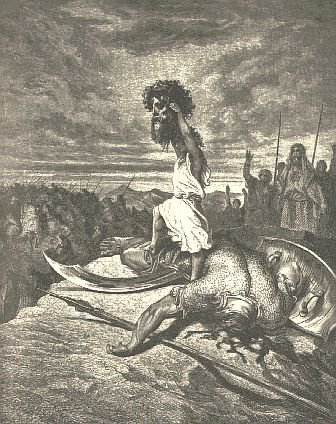 lse, self-referentially absurd, and anti-Christian. Let's quickly dismiss the foolish idea that everything changes. One could refute it by submitting various counter-factuals, or things that do not change. Or, one could be like David and cut off the head of this stupid Goliath with his own sword. If one asserts the proposition "everything changes," then one may ask if that principle itself changes. If X stands for the principle that everything changes, then one may ask if X itself changes?
There are only three options: 1) Everything changes 2) Some things change and 3) Nothing changes. Anyone in their right mind knows that #2 is the case in reality. If one believes #1 is the case, then they have to believe that the proposition or principle of #1 itself changes. If the principle itself changes, then it would have to be false and change into the position of either #2 or #3.
Related to this idea is the notion that the truth itself changes. Some people may think that the truth changes because everything in nature seems to change. I've heard illustrations concerning weather patterns, colors and other things that seem to be relative. These people fail to properly understand the propositional element to truth (truth is not less than the propositional, but it is more than merely propositional), and what is actually being asserted in any given case. Consider a color illustration for an example.
Here's a picture of a dragon. Suppose I utter the proposition, "the dr agon is red." Someone might say that this is relative and illustrates that the truth changes, because the color of the dragon may change under different lighting conditions, or to those color-blind. What they fail to understand is the true nature of the proposition. As I said, I was the one uttering the proposition. The proposition can be clarified by saying, "Tony said the dragon is red." Now, I am not saying that everyone sees the dragon as red when I utter the proposition, so the redness is person sensitive. The proposition is actually, "Tony is being appeared to redly when viewing this dragon." Not only that, one needs to further clarify the proposition because it is time sensitive when uttered. I am typing this at 6:30 am on December 6th, 2005. The true nature of the proposition is this, "Tony is being appeared to redly when viewing this dragon at 6:30am on December 6th, 2005." We might even clarify the location by saying, "Tony is being appeared to redly when viewing this dragon on his computer at 6:30am on December 6th, 2005 in his bedroom in Irving, Texas."
 agon is red." Someone might say that this is relative and illustrates that the truth changes, because the color of the dragon may change under different lighting conditions, or to those color-blind. What they fail to understand is the true nature of the proposition. As I said, I was the one uttering the proposition. The proposition can be clarified by saying, "Tony said the dragon is red." Now, I am not saying that everyone sees the dragon as red when I utter the proposition, so the redness is person sensitive. The proposition is actually, "Tony is being appeared to redly when viewing this dragon." Not only that, one needs to further clarify the proposition because it is time sensitive when uttered. I am typing this at 6:30 am on December 6th, 2005. The true nature of the proposition is this, "Tony is being appeared to redly when viewing this dragon at 6:30am on December 6th, 2005." We might even clarify the location by saying, "Tony is being appeared to redly when viewing this dragon on his computer at 6:30am on December 6th, 2005 in his bedroom in Irving, Texas."
No one in their right mind communicates this way in everday life. We just say "the dragon is red" because we know our listeners automatically understand (at least the sane ones) most of the contextual elements involved. They understand what is being said without all the other tedious details, so we leave them out. But, if we are dealing with people who think the truth changes, then we need to bring out that which is normally understood in order to get to the nature of the truth claim. If we say, "it's raining," we normally mean something like, "it appears to me that it is raining at time (T) in place (P)."
Just because it may not rain at other times, or that I may see the dragon differently in different contexts, it does not follow that the truth has changed. If I turn color-blind tommorrow, it's still true that the dragon appeared redly to me at 6:30am on the given date, and in the given location.
Christians should be the last people to think that the truth changes, or that everything changes. Christianity not only teaches that the truth doesn't change, but that the truth is eternal. Since God exists and is a maximally perfect being possessing all great-making properties (which necessarily includes exhaustive knowledge), it follows that he knows all true propositions. Among the true propositions that God knows eternally is that the dragon would appear redly to Tony in the given place and at the given time. Not only should Christians not think that the truth changes, but they are bound to believe it is eternal! Any other position is self-referentially absurd.
September 28, 2005
Mental Alignment
 If you've driven a car for any length of time, you have probably experienced bad wheel alignment. When the wheels of a car are not in proper alignment, the car tends to veer either to the right or to the left of your intended path. One struggles to hold the steering wheel straight to avoid an accident. A wise person will get the alignment fixed instead of continuing to fight with the steering wheel. Also, the tires will wear down much more quickly if the alignment problem is not corrected.
The Christian life may be compared to driving a car. Disciples are interested in moving toward God as revealed in Christ, so we steer our lives in that direction. Some are driving better than others, but each of us has Christ and his Kingdom as our aim.
There are some people who only want to drive. They don't want to be bothered by looking under the hood and checking the wires and gears. They neglect to check their tire alignment, but commend themselves for struggling to drive. After all, they are "practical." It's too much of a hassle to get into all the detailed analysis of what's going on under the hood and with the tires. "Leave that to the impractical theorists!" they might say.
Too many Christians disdain indepth theological reflection. This is somewhat understandable because of the opposite error. There are many who study theory and "doctrine" without it impacting their lives or affections. They have a kind of "dead orthodoxy." The error of dead orthodoxy is always a danger for the Christian church. We can easily delude ourselves into thinking that the tree of knowledge is the tree of life.
With that said, it seems to me that this is not the tendency today. The prevalent error in our evangelical culture is doctrinal apathy. The "practical" is thought to be antithetical to theology or systematics. Such thinking is unbiblical and foolish.
Scripturally, right thinking is prior to good actions. Paul exhorts believers to be humble and loving by encouraging them to do an indepth reflection on Christ's incarnation. Virtuous affections and actions are never seperated from correct thinking about God as specifically revealed in and through Christ. Right theory joined to the affections drove the Apostles to turn the world upside down for Christ's sake.
I cannot understand any Christian who is not taking time to renew their minds while striving to live to God's glory. The connection between right theory and right practice seems so obvious in the bible. An erroneous thought about God in our thinking can have a ripple effect into every sphere of life, hence the biblical warnings about worshipping God truthfully. The  connections of our thoughts form a complete web of beliefs, and we move in life according to the alignment of the threads. We need to adjust our thinking to be in line with scriptural teaching so that we can move efficiently and wisely through life. Or, to return to the car analogy, we should be concerned about our mental alignment as we seek to move to glorify God by our actions.
 connections of our thoughts form a complete web of beliefs, and we move in life according to the alignment of the threads. We need to adjust our thinking to be in line with scriptural teaching so that we can move efficiently and wisely through life. Or, to return to the car analogy, we should be concerned about our mental alignment as we seek to move to glorify God by our actions.
NKJ Romans 12:2 And do not be conformed to this world, but be transformed by the renewing of your mind, that you may prove what is that good and acceptable and perfect will of God.
"To despise theory is to have the excessively vain pretension to do without knowing what one does, and to speak without knowing what one says." Fontenelle
"Temples have their sacred images; and we see what influence they have always had over a great part of mankind; but, in truth, the ideas and images in men's minds are the invisible powers that constantly govern them; and to these they all pay universally a ready submission." Jonathan Edwards
"It is the habitual thought that frames itself into our life. It affects us even more than our intimate social relations do. Our confidential friends have not so much to do in shaping our lives as thoughts have which we harbor." J. W. Teal
September 22, 2005
Scripture Over System
…it is the duty of the theologian to subordinate his theories to the Bible, and teach not what seems to him to be true or reasonable, but simply what the Bible teaches.Charles Hodge, Systematic Theology, 3 vols. (Grand Rapids: Eerdmans, 1993), 2:559.
September 20, 2005
Some Hate is Good
 Jesus, the Word of God incarnate, drove out the moneychangers who polluted God’s temple by their lies and hypocrisy. The thieves were causing some to blaspheme and others to see religion as a way to financial gain and manipulation. The holy soul of Christ was stirred to godly hatred. His cleansing of the temple illustrates that some hate is good.
He was zealous for truth in religion, and hated that which caused others to stumble. Theological liberals despise this image of the angry Christ, but the faithful disciple knows Christ was filled with righteous indignation. The Word of God knew the law and the prophets, therefore he hated every false way. His love of the Father and his word compelled him to drive out sin.
When we love someone, we do not like others to misrepresent them. We hate those who tell lies about them or distort their words. When we love the truth, we cannot help but hate what is false. Loving truth necessitates hatred of lies, just as the love of plants necessitates the hatred of weeds.
When God plants the truth in our hearts by means of the Holy Spirit speaking through his word, we learn to hate what is false. We delight in those who honestly represent God’s pure word. We are naturally sickened by those who misuse and abuse the scriptures. Those keeping the path to the truth hate the snares that cause others to get trapped and stumble. In fact, one who loves the truth is particularly vexed by errors that seem very close to being true. These errors are very subtle and can easily ensnare the believer.
The saint who is learning holiness is also learning godly hatred. One cannot separate the two anymore than one can separate faith (turning to Truth in Christ) and repentance (away from falsehood and deception). Love rejoices in the truth (I Cor. 13:6), and this presupposes that it also hates lying and all sin.
Consider the following verses for meditation:
NKJ Psalm 119:104 Through Your precepts I get understanding; Therefore I hate every false way.
NKJ Psalm 119:128 Therefore all Your precepts concerning all things I consider to be right; I hate every false way.
NKJ Psalm 119:163 I hate and abhor lying, But I love Your law.
Spurgeon has some great comments on these verses in his The Golden Alphabet. He says,
v. 104 “Therefore I hate every false way.” Because he had understanding, and because of the divine precepts, he detested sin and falsehood. Every sin is a falsehood: we commit sin because we believe a lie, and in the end the flattering evil turns a liar to us, and we find ourselves betrayed. True hearts are not indifferent about falsehood, they grow warm in indignation: as they love the truth, so they hate the lie. Saints have a universal horror of all that is untrue; they tolerate no falsehood or folly, they set their faces against all error of doctrine or wickedness of life. He who is a lover of one sin is in league with the whole army of sins; we must have neither truce nor parley with even one of these Amalekites, for the Lord hath war with them from generation to generation, and so must we. It is well to be a good hater. And what is that? A hater of no living being, but a hater of “every false way.” The way of self-will, of self-righteousness, of self-seeking, of worldliness, of pride, of unbelief, of hypocrisy, of lustfulness – these are all false ways, and therefore not only to be shunned, but to be abhorred.
This final verse of the strophe marks a great advance in character, and shows that the man of God is growing stronger, bolder, and happier than aforetime. He has been taught of the Lord, so that he discerns between the precious and the vile, and while he loves the truth fervently he hates falsehood intensely. May all of us reach this state of discrimination and determination, so that we may greatly glorify God!
v. 128 “And I hate every false way.” Love to truth begat hatred of falsehood. He that prizes a robe abhors the moth which would devour it. This godly man was not indifferent to anything in the moral and spiritual world; but that which he did not love he hated. He was no chip in the porridge without flavour; he was a good lover or a good hater, but he was never a waverer. He knew what he felt, and he expressed it plainly. He was no Gallio, caring for none of these things. His detestation was as unreserved as his affection; he had not a good word for any practice which would not bear the light of truth. The fact that such large multitudes follow the broad road had no influence upon this holy man, except to make him more determined to avoid every form of error and sin. May the Holy Spirit so rule in our hearts that our affections may be in the same decided condition towards the precepts of the word! May we take our place on the side of God and righteousness, and never bear the sword in vain! We would not be pugnacious, but we dare not be sinfully indifferent. All sin we must hate; for any one of the whole tribe will be our ruin if it be indulged. To arms! To arms! ye soldiers of the cross.
v. 163 “I hate and abhor lying.” A double expression for an inexpressible loathing. Falsehood in doctrine, in life, or in speech, falsehood in any form or shape, had become utterly detestable to the Psalmist. This was a remarkable statement for an Oriental to make; for, generally, lying is the delight of the Easterns, and the only wrong they see in it is when their skill is at fault, so that the lie is found out. David himself had made much progress when he had come to this; for he, too, had practised guile in his day. He does not, however, alone refer to falsehood in conversation; he evidently intends perversity in faith and teaching. He wrote down all opposition to the God of truth as lying, and then he turned his whole soul against it with the intensest form of indignation. Godly men should detest false doctrine even as they abhor any other lie.
August 25, 2005
Kuyper on Diverse Literary Forms
Keith Plummer, of The Christian Mind, sent me this quote from Abraham Kuyper about a month ago. I am not sure of the source for this quote, but it is brilliant. It addresses the significance of the diverse literary forms in scripture.
There is a tendency among evangelicals to reduce the bible to the propositional. It's as if the expressions are getting in the way of our formation of propositional checklists. Our reductionistic mentality bypasses the significance of the diverse literary forms found in the bible, which were purposefully inspired by the Holy Spirit. These diverse literary forms are put there to address the whole person, not merely man's cognitive faculties. Truth is not less than the propositional, but it is much more. Here's the Kuyper quote:
"Man received in his creation more than one string to the harp of his soul, and according to the nature of the objects that hold his attention his mood changes, he strikes a different key, and his mental action assumes new phases....Thus the human mind is disposed by nature to a multiformity of expression, which sustains connection with the multiformity of material that engages our attention. And since there is a wide difference in the material that constitutes the content of Revelation, it is entirely natural that the inspiration of the Holy Spirit has made use of that multiformity of our spiritual expression, and thus assumes at one time a lyric character, at another time an epical, sometimes even a dramatic, but especially also one that is didactic. To some extent one may even say that in these aesthetic variegations certain fundamental forms are given for inspiration, and if need be the entire content of the Scripture might be divided after these four fundamental types."
August 17, 2005
The Right Questions Book Excerpts
I was listening to a radio interview with Phillip E. Johnson regarding his book The Right Questions: Truth, Meaning and Public Debate. He mentioned that everyone ought to read Nancy Pearcey's Foreward. Here is the link to read excerpts from that book:
July 17, 2005
The Way to Study
He that studies only men, will get the body of knowledge without the soul; and he that studies only books, the soul without the body. He that to what he sees, adds observation, and to what he reads, reflection, is in the right road to knowledge, provided that in scrutinizing the hearts of others, he neglects not his own.Colton, cited in The New Dictionary of Thoughts
NKJ Philippians 4:9 The things which you learned and received and heard and saw in me, these do, and the God of peace will be with you.
It would have been amazing to witness the lives of the prophets and Apostles, to look at them intently and meditate on their actions. This is what the Apostles did in watching Jesus. They "beheld his glory" and pondered his words. They observed how he treated people, and how each word was spoken with wisdom. The sound, volume, and nature of his words exactly fitted the needs of the situation. The majestic character of Christ came through in everything he did, and his followers gazed upon him in wonder and adoration.
NKJ John 1:14 And the Word became flesh and dwelt among us, and we beheld His glory, the glory as of the only begotten of the Father, full of grace and truth. (possibly my favorite verse)
If you see anyone like him, watch them. Think about what they are doing and saying. Study them. Be transformed by witnessing their lives. Treasure up their words in your heart as Mary did with Jesus' words. This is how to study.
Subscribe to:
Posts (Atom)
