Showing posts with label High Calvinism. Show all posts

June 19, 2010

Curt Daniel on the Connection Between the “All” of the Atonement and the “Revealed Salvific Will of God”

We call attention to Calvin’s warning that if one limits the ‘all’ of the atonement, then one limits the revealed salvific will of God, which necessarily infringes on the preaching of the gospel and diminishes the “hope of salvation” of those to whom the Gospel is preached. Both High and Hyper-Calvinists fell prey to Calvin’s warning. The former limited the atonement and opened the door to limiting the revealed will that all be saved. Hyper-Calvinists went through that door and logically diminished the Gospel ministry and content.
Curt Daniel, Hyper-Calvinism and John Gill (Unpublished Ph.D. dissertation, University of Edinburgh, 1983), 603.

October 1, 2009

A Few Historical References by John Humfrey (1621–1719) on the Redemption Controversy

Sir, you know there are two sorts of such as oppose Arminianism. One that is the high sort, and the other the moderate sort that are for the middle way in these Controversies, and I confess myself one who have wrote several pieces, so called. We that are of this sort, do hold Election to be of particular persons (not the choosing Believers to be saved with the Arminian and Lutherans, but the choosing Persons to believe): But Redemption we hold to be Universal. The Scriptures say, Christ died for all, and for every man. God so loved the World, (says Christ) that he gave his only begotten Son, that whosoever believeth in him should not perish, but have everlasting life. By the World, this Gentlemen must understand the Elect: but when by the words [that whosoever believeth in him] Christ plainly intimates, that there are some of those God loves, do believe, and some not; the World must be more than the Elect. Of the world of those God loves so as to give his Son, to dye for them; some believe in him, and have everlasting life, and some believe not and perish. But of the Elect all believe, and none perish.

One Text more I will quote: Whom he did predestinate, them he called: Whom he called, them he justified: Whom he justified, them he also glorified. And why is Redemption here left out of the Apostolical Chain, but because those he hath redeemed, are all the world? If the Doctrine that this Gentleman hath received were right, the Apostle would have said, Whom he did predestinate, them he Redeemed.

I shall use no more Arguments, or Scriptures, when so many may be had; but because this Gentleman was apt to think me singular in what I said, it is fit he know that the Church of England (and consequently our Holy Martyrs, Cranmer, Ridley, Latimer, Bradford,) does in her Catechism assert this Doctrine, when the child is made to answer there, Who hath redeemed me and all mankind. The excellent Dr. Bishop Davenant, hath wrote a Book on purpose, De Morte Christi, to maintain this point. Archbishop Usher (not to name any of our Eminent forraign Divines) hath done the like. Mr. Baxter, that every foot is commending this book of Davenants so highly, is one, I won't scruple to say now he is dead, no less profound himself, and chose to go this way with them.
John Humfrey, Peace at Pinners-Hall (London: Printed and be Sold by Randal Taylor near Amen-Corner, 1692), 2–4.

Observe the following points in the above:

1) Humfrey distinguishes between the two sorts of Calvinists who oppose Arminianism: the "high sort" and the "moderates."
2) The "moderates" hold to a form of universal redemption.
3) He lists Cranmer, Ridley, Latimer, Bradford, Davenant, Ussher and Baxter as "moderates."

Note (5-8-13): Joseph Truman also calls himself a "moderate" several times in opposing certain free will theologians in A Discourse of Natural and Moral Impotency (London: Printed for Robert Clavel; and are to be sold at the Sign of the Peacock in St. Pauls Church yard, 1675). See, for example, pp. 115, 124.

November 8, 2008

Conference Chart

Here is a modified pdf copy of the chart I created in 2008 for Dr. David Allen to use at the John 3:16 Conference:


It compares Arminianism, Classic/Moderate Calvinism, High Calvinism and Hyper-Calvinism on 8 different (but related) topics:

1) God’s Love
2) God’s Will
3) God’s Grace
4) Gospel Offers
5) Christ’s Death, or the Extent of Expiation and Redemption
6) Sufficiency
7) Human Ability
8) Responsibility

I believe he made enough copies for about 800 people, and I see that one person already has a low quality scan of it online. So, here is a much better copy to distribute.

Also, I did a radio interview (click) (or here) on this chart that may be helpful for further explanation.


Update on 9-27-11: In retrospect, I think Andrew Fuller’s name should be qualified since he changed his position later in life. He was a High Calvinist on the atonement early on, then switched to the moderate camp later. Also, William Carey’s views are not yet known (insufficient documents), so he should not be listed, not even as a High Calvinist. When I made the original chart, I was not sure about Fuller’s switch, so I assumed he and Carey were both High Calvinists. I have updated the “Notable Representatives” section of the chart to reflect these facts and others.

Update on 4-17-23: Curt Daniel’s new edition of the History and Theology of Calvinism (Darlington, UK: Evangelical Press, 2019) has shown that he explicitly opts for a limited imputation of sin to Christ (see esp. pp. 509–521). On page 519, for example, he wrote: “The sins of the elect alone were imputed to Christ, and His righteousness is imputed to them. The two imputations match.… He bore the curse only of those who will not finally be cursed—that is, the elect.” He should not, therefore, at least at this point, be classified as a classic-moderate Calvinist. One could reasonably argue that he came across as moderate in both his doctoral dissertation and in other earlier writings and statements. His name has now been deleted from the moderate representatives because of the fact that he is among the stricter sort, just with a broad understanding of the common grace benefits that flow to all from Christ’s death (or what he vaguely likes to call a “universal aspect”).


December 18, 2007

My Historical Documentation

For those who don't know already, I have been documenting the thoughts of the Puritans and other Calvinistic thinkers on the subject of the revealed will of God for quite some time. I am seeking to show that they held to the following:

1) God's general love for mankind is expressed in a universal will to save, and the benefits of common grace are granted to move men to repentance and salvation.

2) God himself gives well-meant offers to all through the gospel call.

All of the Puritans and Calvinistic thinkers on my blog held to the above two propositions. However, even though they affirmed the content of these two propositions, they were of two sorts:

Type A: Christ suffered for the sins of all mankind

Type B: Christ suffered only for the sins of the elect

This may be illustrated as follows:

Since I am in the Type A category (i.e., classic or moderate Calvinism), I have particularly focused on documenting historical Calvinists in this group. Nevertheless, I respect and recognize as orthodox those who are within the Type B tradition (i.e., high Calvinists), so long as they do not reject the above two propositions. As for those who reject the two propositions above (i.e., hyper-Calvinists who are not within the Type A or Type B groups), they often accuse me of taking men out of context. They not only fail to demonstrate how this is, but they do not even interact with my primary source documentation. How could they? This is about all I expect from what I am documenting. If my critics can only deny my claims without proving their case historically, or even interacting with my sources, then they are successfully refuted, at least in terms of historical matters. What they surely do not have is "a Puritans mind," despite their self-descriptions.

May 8, 2007

Reid's Confession

Reid Ferguson, of Responsive Reiding, has posted an interesting confession. It's one that I can relate to.


p.s. Reid, please take that accursed snap feature off of your blog ;-)

June 28, 2006

An Explanation of a Few Calvinistic Labels

I’ve had to explain some of my terminology to a few people recently, so I may as well put the material on my blog. I posted the following material on a discussion board:

By “High Calvinism,” I mean those who adhere to a strictly limited view of the design of Christ’s death (the intent was to save the elect alone). It’s the most popular view today due to the recent proliferation of Puritan literature and/or Protestant Scholastic writings. Some people associate High Calvinism with supralapsarianism (rather than with infralapsarianism). So, in their view, infralapsarianism is Moderate or Low. That’s very common way of categorizing, but erroneous in my opinion. Here’s how I would classify things:

HYPER-CALVINISM = Strict particularist, supralapsarian (mostly) Calvinism that denies either (1) the universal love of God, or (2) common grace, or (3) the free/well-meant gospel offer, or (4) duty-faith, or all the above. Some (not all) of these may even believe in equivalentism, such that Christ suffered just so much for so many elect sins.

HIGH CALVINISM = Strict Particularist Calvinism that is either supralapsarianism (not all supra’s are hyper), or infralapsarian. There are higher high’s (supra’s) and lower highs (infra’s). Some in this group may even reject lapsarianism (such as H. Bavinck, Reformed Dogmatics: God and Creation, ed. by John Bolt and trans. by John Vriend [Grand Rapids: Baker Academic, 2004], 2:388–92). They believe there is a universal love of God, common grace, free/good-will offers, and duty-faith. They hold to the sufficiency of Christ’s death in the sense that it’s of infinite intrinsic value (a bare sufficiency), but not in the sense that he bore the guilt for the sins of all mankind (which is historically called an ordained or extrinsic sufficiency). They believe that Christ was punished or substituted for the guilt of the elect alone, as their sins alone were imputed to Christ, but most of these reject equivalentism. The majority of them also believe that common grace flows to all because of Christ’s satisfaction. In that sense, and in that sense alone, there is a “universal aspect.”

CLASSIC OR MODERATE CALVINISM = Non-strict Calvinism, or those who believe in a universal substitution, that may or may not hold to a form of ordered decretalism/lapsarianism (if so, they would most likely be infralapsarian). R. L. Dabney, a moderate Calvinist, rejected lapsarian speculation. They say that Christ suffered sufficiently for all (in the sense of an ordained sufficiency), but especially for the elect (with a limited special intent to save them alone, resulting in the special effectual application). Basically, they are dualists. They also usually see a connection between Christ’s death and common grace as well, but their “universal aspect” is more than this (thus differing from High’s), as it also includes Christ substituting Himself for all mankind sinners.

LOW CALVINISM = Those who profess to hold the other four points, but say that Christ died for all without making careful qualifications. It seems that they teach that Christ intended to die equally for all. I tend to put self-described “three-pointers” in this group as well, but they are difficult to categorize. They may quibble over “irresistible grace.” Robert P. Lightner (1931–2018), for example, might be placed in this category.

For more on this, you may wish to check this chart that I made. It lists some of the representatives. I discussed this chart in a radio interview with Gene Cook in November of 2008.

June 27, 2005

Stereoscopic Calvinism

Shortly after my conversion, I became a Calvinist through reading a study bible that had some notes by Matthew Henry, and also by listening to John MacArthur preach through Romans 9. I was not aware that what I believed was called Calvinism, but I understood my own moral inability and something of God's sovereignty. I started reading the bible with a greater understanding of God's secret will (sometimes called the decretive will). God's complete sovereignty seemed to pervade every page of the bible. I was being trained by preachers and by books to think of God as much bigger than I ever imagined. I read books by R. C. Sproul that broadened my theological horizons. Discerning the sovereignty of God in scripture and in my own life brought comfort, excitement, godly fear and zeal for this truth. I was suspicious of anyone who seemed to threaten this sovereign perspective on God.

What I did not know for a long time (about 12 or 13 years) was that I was neglecting significant passages of scripture that bring balance to this issue. I had been reading the bible with one eyeball so to speak. My decretive eye was very strong and seemed to focus on the passages that confirmed my decretal bent. It was not until conversations with friends on the subject of Hyper-Calvinism that I began to become more epistemologically self-aware. I had only reacted against Arminianism and similar theologies, but I never reacted against the errors of Hyper-Calvinism. I was not really aware of what Hyper-Calvinism was until I studied it a few years ago. Phil Johnson has observed what is perhaps the major problem with Hyper-Calvinism. He said that "in all their discussion of "the will of God," hyper-Calvinists routinely obscure any distinction between God's will as reflected in His commands and His will as reflected in his eternal decrees. Yet that distinction is an essential part of historic Reformed theology." Hyper-Calvinists read the bible with one eyeball. They see the decretive/secret will of God so plainly, and they get confused when one affirms the biblical teaching with regard to God's will as reflected in his commands. This is called the preceptive or revealed will of God. Arminians make a similar error, and only see the biblical teaching on the revealed will of God. They fear coming to Hyper-Calvinist conclusions about God and the biblical teaching, and rightly so. R. L. Dabney describes both sides of the imbalance when he said:
Say that God has no secret decretive will, and He wishes just what He commands and nothing more, and we represent Him as a Being whose desires are perpetually crossed and baffled: yeah, trampled on; the most harassed, embarrassed, and impotent Being in the universe. Deny the other part of our distinction (he means the preceptive will here), and you represent God as acquiescing in all the iniquities done on earth and in hell.
Both of these theological systems, Arminianism and Hyper-Calvinism, represent a myopic or cycloptic way of reading the bible. It makes them dizzy to consider opening the closed eye in order to look at things stereoscopically. They suspiciously peer at anyone who tries to open their other eyelid. Those looking stereoscopically at scripture are viewed as holding a contradictory position. The bifocal or dualistic theologian, who wholeheartedly affirms the secret/revealed will of God distinction, gets hit from both sides.

In studying the errors of Hyper-Calvinism, I finally came to a better grasp of volitional complexity in God. My preceptive eye was growing dim from lack of use. I was suffering from a decretal bent of mind, and this was impacting my Christian life and hermeneutical responsibilities. I was not representing God to the world as I should have. My heart was growing cold toward people, and I tended to take a passive 'let go and let God' view of things. I was not zealous for human responsibility, nor was I properly understanding the heart of God toward all lost sinners. God is compassionate and loving toward those he has not elected to everlasting life. Affirming this is no threat to Calvinistic teaching. It is not contradictory, but only appears to be to those looking through one hermeneutical eyeball.

Consider the following passages regarding God's will:

NKJ Mar 3:35 "For whoever does the will of God is My brother and My sister and mother."

NKJ Luk 7:30 But the Pharisees and lawyers rejected the will of God for themselves, not having been baptized by him.

NKJ Rom 12:2 And do not be conformed to this world, but be transformed by the renewing of your mind, that you may prove what is that good and acceptable and perfect will of God.

NKJ Eph 6:6 not with eyeservice, as men-pleasers, but as bondservants of Christ, doing the will of God from the heart,

NKJ Col 4:12 Epaphras, who is one of you, a bondservant of Christ, greets you, always laboring fervently for you in prayers, that you may stand perfect and complete in all the will of God.

NKJ 1Th 4:3 For this is the will of God, your sanctification: that you should abstain from sexual immorality;

NKJ 1Th 5:18 in everything give thanks; for this is the will of God in Christ Jesus for you.

NKJ Heb 10:36 For you have need of endurance, so that after you have done the will of God, you may receive the promise:

NKJ 1Pe 2:15 For this is the will of God, that by doing good you may put to silence the ignorance of foolish men --

NKJ 1Pe 4:2 that he no longer should live the rest of his time in the flesh for the lusts of men, but for the will of God.

NKJ 1Jo 2:17 And the world is passing away, and the lust of it; but he who does the will of God abides forever.

NKJ Rom 2:18 and know His will, and approve the things that are excellent, being instructed out of the law,

NKJ Eph 5:17 Therefore do not be unwise, but understand what the will of the Lord is.

NKJ Joh 7:17 "If anyone wants to do His will, he shall know concerning the doctrine, whether it is from God or whether I speak on My own authority.

NKJ Psa 51:6 Behold, You desire truth in the inward parts, And in the hidden part You will make me to know wisdom.

NKJ 1Jo 5:14 Now this is the confidence that we have in Him, that if we ask anything according to His will, He hears us.

I believe that all of these passages refer to the will of God in the revealed or preceptive sense. These passages do not contradict those that affirm that the will of God is always accomplished. They just refer to God's will in a different sense. If we learn to distinguish between the biblical senses of words and ideas, then we can learn to look at God stereoscopically and draw near to God. If we relax and allow the bible to affirm what it affirms without imposing our systems on it, then we will come to know God in truth. God may hide himself behind seeming contradictions, but he is not contradictory. He is complex, but not inconsistent with himself.

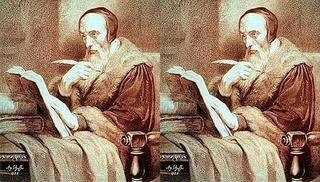
Look again at the picture of John Calvin above and let your eyes relax. Look at is as you would with a magic eye picture or stereogram. Eventually, you will get a 3D effect because your eyes are both open and relaxed. You will know you are getting the effect when it appears as if three pictures of John Calvin are there. This serves to illustrate the hermeneutical point about God's will, but it also applies to many other areas of theology. We tend to autonomously impose our systems upon the text of scripture and not allow it to correct us. The truth is in a stereocopic Calvinism, and not in a monofocal Hyperism or Arminianism. I will say more on this in the future. Those interested in more on this may click the links on the right side of this page. Listen to Curt Daniel's audio lectures on The History and Theology of Calvinism, and read R. L. Dabney's God's Indiscriminate Proposals of Mercy. These resources are very good. That Dabney article can be found here: God's Indiscriminate Proposals of Mercy