Showing posts with label Meditation. Show all posts

November 12, 2014

Douglas Groothuis and Kierkegaard on Silence and Truth

Diversions and the omnipresent noise and clutter of contemporary culture erect barriers to the serious and disciplined pursuit of truth. Although I do not believe it is included in any apology for the Christian worldview (it is scarcely mentioned anywhere at all), one of the key elements in considering Christian truth claims is not an argument at all, but a condition in which arguments may be understood and appreciated. That condition is silence. No one has stated it better than Kierkegaard, who wrote before the onset of electrification and its manifold mind-numbing media.
In observing the present state of affairs and of life in general, from a Christian point of view one would have to say: It is a disease. And if I were a physician and someone asked me, "What do you think should be done?" I would answer, "Create silence, bring about silence." God's Word cannot be heard, and if in order to be heard in the hullabaloo it must be shouted deafeningly with noisy means, then it is not God's Word; create silence!

And we humans, we clever fellows, seem to have become sleepless in order to invent every new means to increase noise, to spread noise and insignificance with the greatest possible ease and on the greatest possible scale. Yes, everything has been turned upside down. The means of communication have been perfected, but what is publicized with such hot haste is rubbish. Oh, create silence!45
In the silence of rational reflection, truth may disclose itself to the receptive soul.46
_______________
45. Kierkegaard, in Provocations, p. 372. For an absorbing treatment of the meaning of silence, see Max Picard, The World of Silence, trans. Stanley Goodman (Chicago: Henry Regnery, 1952).
46. On the dangers of diversion in our technological society see Douglas Groothuis, The Soul in Cyberspace (Grand Rapids: Baker, 1997).

Groothuis also posted the Kierkegaard quote on his old blog here (click).

Thanks to Carrie Hunter for bringing this quote in Groothuis' book to my attention.

November 25, 2006

Peter Toon on the Divine Art of Meditation

St. Thomas' Episcopal Church has three sermon series available online by Dr. Peter Toon. Here are the files for the series on The Divine Art of Meditation:

Peter Toon: The Divine Art of Meditation: 1 of 4 (8/7/2005)

Peter Toon: The Divine Art of Meditation: 2 of 4 (8/14/2005)

Peter Toon: The Divine Art of Meditation: 3 of 4 (8/20/2005)

Peter Toon: The Divine Art of Meditation: 4 of 4 (8/27/2005)

Other messages available:

HEAVEN, already but not yet:
Sermon 1. "We shall rest"
Sermon 2. “We shall see.”
Sermon 3. "We Shall Love"
Sermon 4. "We Shall Praise"

Fear & Love, inseparable twins (also in 4 parts)

Toon's written material on meditation can also be found HERE.

February 2, 2006

Solitude and Meditation

Michael Haykin posts some interesting comments to encourage the forgotten practice of solitude and meditation here:

November 27, 2005

Thomas the Day Dreamer (Part 2)

The following is also taken from G. K. Chesterton's book on Saint Thomas Aquinas. Chapter IV is titled A Meditation on the Manichees. Manichaeism was an ancient heresy that the early church had to deal with, and the ideas persisted into the middle ages. Their beliefs are described by The Columbia Encyclopedia this way:
Basic to the religion’s doctrine was the conflicting dualism between the realm of God, represented by light and by spiritual enlightenment, and the realm of Satan, symbolized by darkness and by the world of material things. To account for the existence of evil in a world created by God, Mani posited a primal struggle in which the forces of Satan separated from God; humanity, composed of matter, that which belongs to Satan, but infused with a modicum of godly light, was a product of this struggle, and was a paradigm of the eternal war between the forces of light and those of darkness. Christ, the ideal, light-clad soul, could redeem for each person that portion of light God had allotted. Light and dark were seen to be commingled in our present age as good and evil, but in the last days each would return to its proper, separate realm, as they were in the beginning. The Christian notion of the Fall and of personal sin was repugnant to the Manichees; they felt that the soul suffered not from a weak and corrupt will but from contact with matter. Evil was a physical, not a moral, thing; a person’s misfortunes were miseries, not sins.
Chesterton describes a social situation in which Thomas is participating in a royal banquet. He was courteous to all that spoke with him, but he spoke little. Rather than thinking about the noisy clatter around him, his mind was meditating on how to refute Manichaeism. Chesterton tells the story this way:
There is one casual anecdote about St. Thomas Aquinas which illuminates him like a lightening-flash, not only without but within. For it not only shows him as a character, and even as a comedy character, and shows the colours of his period and social background; but also, as if for an instant, makes a transparency of his mind. It is a trivial incident which occurred one day, when he was reluctantly dragged from his work, and we might almost say from his play. For both were for him found in the unusual hobby of thinking, which is for some men a thing much more intoxicating than mere drinking. He had declined any number of society invitations, to the courts of kings and princes, not because he was unfriendly, for he was not; but because he was always glowing within with the really gigantic plans of exposition and argument which filled his life. On one occassion, however, he was invited to the court of King Louis IX of France, more famous as the great St. Louis; and for some reason or other, the Dominican authorities of his Order told him to accept; so he immediately did so, being an obedient friar even in his sleep; or rather in his permanent trance of reflection.

It is a real case against conventional hagiography that it sometimes tends to make all saints seem to be the same. Whereas in fact no men are more different than saints; not even murderers. And there could hardly be a more complete contrast, given the essentials of holiness, than between St. Thomas and St. Louis. St. Louis was born a knight and a king; but he was one of those men in whom a certain simplicity, combined with courage and activity, makes it natural, and in a sense easy, to fulfill directly and promptly any duty or office, however official. He was a man in whom holiness and healthiness had no quarrel; and their issue was in action. He did not go in for thinking much, in the sense of theorising much. But, even in theory, he had that sort of presence of mind, which belongs to the rare and really practical man when he has to think. He never said the wrong thing; and he was orthodox by instinct. In the old pagan proverb about kings being philosophers or philosophers kings, there was a certain miscalculation, connected with a mystery that only Christianity could reveal. For while it is possible for a king to wish very much to be a saint, it is not possible for a saint to wish very much to be a king. A good man will hardly be always dreaming of being a great monarch; but, such is the liberality of the Church, that she cannot forbid even a great monarch to dream of being a good man. But Louis was a straightforward soldierly sort of person who did not particularly mind being a king, any more than he would have minded being a captain or a sergeant or any other rank in his army. Now a man like St. Thomas would definitely dislike being a king, or being entangled with the pomp and politics of kings; not only his humility, but a sort of subconscious fastidiousness and fine dislike of futility, often found in leisurely and learned men with large minds, would really have prevented him making contact with the complexity of court life. Also, he was anxious all his life to keep out of politics; and there was no political symbol more striking, or in a sense more challenging, at that moment, than the power of the King in Paris.

Paris was truly at that time an aurora borealis; a Sunrise in the North. We must realise that lands much nearer to Rome had rotted with paganism and pessimism and Oriental influences of which the most respectable was that of Mahound. Provence and all the South had been full of a fever of nihilism or negative mysticism, and from Northern France had come the spears and swords that swept away the unchristian thing. In Northern France also sprang up that splendour of building that shines like swords and spears: the first spires of the Gothic. We talk now of grey Gothic buildings; but they must have been very different when they went up white and gleaming into the northern skies, partly picked out with gold and bright colours; a new flight of architecture, as startling as flying ships. The new Paris ultimately left behind by St. Louis must have been a thing white like lilies and splendid as the oriflamme. It was the beginning of the great new thing: the nation of France, which was to pierce and overpower the old quarrel of Pope and Emperor in the lands from which Thomas came. But Thomas came very unwillingly, and, if we may say it of so kindly a man, rather sulkily. As he entered Paris, they showed him from the hill that splendour of new spires beginning, and somebody said something like, "How grand it must be to own all this." And Thomas Aquinas only muttered, "I would rather have that Chrysostom MS. I can't get hold of."

Somehow they steered that reluctant bulk of reflection to a seat in the royal banquet hall; and all that we know of Thomas tells us that he was perfectly courteous to those who spoke to him, but spoke little, and was soon forgotten in the most brilliant and noisy clatter in the world: the noise of French talking. What the Frenchmen were talking about we do not know; but they forgot all about the large fat Italian in their midst, and it seems only too possible that he forgot all about them. Sudden silences will occur even in French conversation; and in one of these interruption came. There had long been no word or motion in that huge heap of black and white weeds, like motley in the mourning, which marked him as a mendicant friar out of the streets, and contrasted with all the colours and patters and quarterings of that first and freshest dawn of chivalry and heraldry. The triangular shields and pennons and pointed spears, the triangular swords of the Crusade, the pointed windows and the conical hoods, repeated everywhere that fresh French medieval spirit that did, in every sense, come to the point. But the colours of the coats were gay and varied with little to rebuke their richness; for St. Louis, who had himself a special quality of coming to the point, had said to his courtiers, "Vanity should be avoided; but every man should dress well, in the manner of his rank, that his wife may the more easily love him."

And then suddenly the goblets leapt and rattled on the board and the great table shook, for the friar had brought down his huge fist like a club of stone, with a crash that startled everyone like an explosion; and had cried out in a strong voice, but like a man in the grip of a dream, "And that will settle the Manichees!"

The palace of a king, even when it is the palace of a saint, has its conventions. A shock thrilled through the court, and every one felt as if the fat friar from Italy had thrown a plate at King Louis, or knocked his crown sideways. They all looked timidly at the terrible seat, that was for a thousand years the throne of the Capets; and man there were presumably prepared to pitch the big black-robed beggarman out of the window. But St. Louis, simple as he seemed, was no mere medieval fountain of honour or even fountain of mercy; but also the fountain of two eternal rivers; the irony and the courtesy of France. And he turned to his secretaries, asking them in a low voice to take their tablets round to the seat of the absent-minded controversialist, and take a note of the argument that had just occurred to him; because it must be a very good one and he might forget it. I have paused upon this anecdote, first, as has been said, because it is the one which gives us the most vivid snapshot of a great medieval character; indeed of two great medieval characters. But it is also specially fitted to be taken as a type or a turning-point, because of the glimpse it gives of the man's main preoccupation; and the sort of thing that might have been found in his thoughts, if they had been thus suprised at any moment by a philosophical eavesdropper or through a psychological keyhole. It was not for nothing that he was still brooding, even in the white court of St. Louis, upon the dark cloud of the Manichees.
G. K. Chesterton, Saint Thomas Aquinas "The Dumb Ox" (New York: Doubleday, 1956), 74–78.

November 26, 2005

Thomas the Day Dreamer (Part 1)

G. K. Chesterton was an excellent writer, and this is very apparent in his book on Thomas Aquinas, aka "The Dumb Ox". I love the way Chesterton describes Thomas as one who was sometimes "absent-minded" and a "day dreamer." I suppose the following quote stands out to me because I tend to day dream when I am around family members during the holidays. Our holiday practices seem to be like modern shells devoid of their pre-modern substance. We go through the motions and externals without thinking about the significance of what we are doing, or about the transcendent origins of the truths contained in the traditions.

Since no one in my immediate family is a Christian, it is normal for the conversations to be largely trivial and uninteresting. You might call the conversations "small talk." I understand how some may interpret my descriptions as being condescending, but they are not. They are capable of understanding anything that I can, but they don't want to.

Most people, particularly in my culture and family context, engage in small talk to avoid potentially painful thinking (topics that would trouble their conscience), or thinking that may disrupt "peaceful" relationships. It seems as if conversations are deliberately kept at a superficial level so that everyone can just get along and not be troubled by ultimate questions. Occasionally I try to tactfully introduce topics concerning ideas, but usually things quickly return to a focus on people, events and other trivialities as we mindlessly sit in front of the television. So, for the most part, I find myself going through the motions of our cultural activities while day dreaming about ideas. I tend to be absent-minded in this regard. Chesterton's descriptions of Thomas have helped me to understand a little bit about myself.

Here is an excerpt from Chesterton's book that I think is outstanding:
The pictures of St. Thomas, though many of them painted long after his death, are all obviously pictures of the same man. He rears himself defiantly, with the Napoleonic head and the dark bulk of body, in Raphael's "Dispute About the Sacrament." A portrait by Ghirlandajo emphasises a point which specially reveals what may be called the neglected Italian quality in the man. It also emphasises points that are very important in the mystic and the philosopher. It is universally attested that Aquinas was what is commonly called an absent-minded man. That type has often been rendered in painting, humorous or serious; but almost always in one of two or three conventional ways. Sometimes the expression of the eyes is merely vacant, as if absent-mindedness did really mean a permanent absence of mind. Sometimes it is rendered more respectfully as a wistful expression, as of one yearning for something afar off, that he cannot see and can only faintly desire. Look at the eyes in Ghirlandajo's portrait of St. Thomas; and you will see a sharp difference. While the eyes are indeed completely torn away from the immediate surroundings, so that the pot of flowers above the philosopher's head might fall on it without attracting his attention, they are not in the least wistful, let alone vacant. There is kindled in them a fire of instant inner excitement; they are vivid and very Italian eyes. The man is thinking about something; and something that has reached a crisis; not about nothing or about anything; or, what is almost worse, about everything. There must have been that smouldering vigilance in his eyes, the moment before he smote the table and startled the banquet all of the King.

Of the personal habits that go with the personal physique, we have also a few convincing and confirming impressions. When he was not sitting still, reading a book, he walked round and round the cloisters and walked fast and even furiously, a very characteristic action of men who fight their battles in the mind. Whenever he was interrupted, he was very polite and more apologetic than the apologizer. But there was that about him, which suggested that he was rather happier when he was not interrupted. He was ready to stop his truly Peripatetic tramp: but we feel that when he resumed it, he walked all the faster.

All this suggests that his superficial abstraction, that which the world saw, was of a certain kind. It will be well to understand the quality, for there are several kinds of absence of mind, including that of some pretentious poets and intellectuals, in whom the mind has never been noticeably present. There is the abstraction of the contemplative, whether he is the true sort of Christian contemplative, who is contemplating Something, or the wrong sort of Oriental contemplative, who is contemplating Nothing. Obviously St. Thomas was not a Buddhist mystic; but I do not think his fits of abstraction were even those of a Christian mystic. If he has trances of true mysticism, he took jolly good care that they should not occur at other people's dinner-tables. I think he had the sort of bemused fit, which really belongs to the practical man rather than the entirely mystical man. He uses the recognized distinction between the active life and the contempletive life, but in the cases concerned here, I think even his contemplative life was an active life. It had nothing to do with his higher life, in the sense of ultimate sanctity. It rather reminds us that Napoleon would fall into a fit of apparent boredom at the Opera, and afterwards confess that he was thinking how he could get three army corps at Frankfurt to combine with two army corps at Cologne. So, in the case of Aquinas, if his daydreams were dreams, they were dreams of day; and dreams of the day of battle. If he talked to himself, it was because he was arguing with somebody else. We can put it another way, by saying that his daydreams, like the dreams of a dog, were dreams of hunting; of pursuing the error as well as pursuing the truth; of following all the twists and turns of evasive falsehood, and tracking it at last to its lair in hell. He would have been the first to admit that the erroneous thinker would probably be more surprised to learn where his thought came from, than anybody else to discover where it went to. But this notion of pursuing he certainly had, and it was the beginning of a thousand mistakes and misunderstandings that pursuing is called in Latin Persecution. Nobody had less than he had of what is commonly called the temper of a persecutor; but he had the quality which in desperate times is often driven to persecute; and that is simply the sense that everything lives somewhere, and nothing dies unless it dies in its own home. That he did sometimes, in this sense, "urge in dreams the shadowy chase" even in broad daylight, is quite true. But he was an active dreamer, if not what is commonly called a man of action; and in that chase he was truly to be counted among the domini canes; and surely the mightiest and most magnanimous of the Hounds of Heaven.
G. K. Chesterton, Saint Thomas Aquinas "The Dumb Ox" (New York: Doubleday, 1956), 98–101.

See also Thomas the Day Dreamer (Part 2)

November 22, 2005

Noise and Meditation

Keith Plummer has posted an excellent link on his blog to an article entitled A Kingdom of Noise. It's well worth reading.

The author, Erik Lokkesmoe, writing as if he were C. S. Lewis's senior demon named Screwtape, says to Wormwood (a demon in training):
But oh, how dreadful it is if they do notice and, worse yet, begin to reject the delightful opiates we offer. An hour’s walk or an evening alone can be hazardous. Even a drive with a broken radio carries risk. Peace and quietude, after all, are the Enemy's handiwork. He waits patiently for them in the stillness, whispering for them to rest or ponder or, dare I say that repulsive word, meditate.

I trust you understand what is at stake. If allowed to contemplate the empty pursuits and hollow activity that often fill their days, there is no telling what horrific changes they may make in their lives. As long as the volume is high and the lights are flashing, there is little danger of this. But when allowed to face things as they really are, stripped of the comfort provided by our dizzying distractions, our subjects often choose against our ways.

This kind of activity, or rather inactivity, is a breeding ground for all manner of destructive outcomes. Rest gives them refreshed bodies and clear minds. Clarity draws them to that which we most hate: truth. In such moments their vision grows strong and purpose is rekindled. For Hell’s sake, do not let this happen!

September 30, 2005

John Owen (1616–1683) on Meditation

I recently listened to John Piper's lecture on John Owen and heard the following quotation. It partially explains why so many of my posts are related to Calvinism, the Gospel and the atonement. An improper understanding of what God was doing in the death of his Son will eventually impact every other area of our thinking, even in the way we form our beliefs and interpret scripture. I am trying to think deeply about Christ as revealed in the gospel. Every doctrine is ultimately related to the revelation of God in Christ on the cross. The importance of thinking about these issues should be obvious, but John Owen in Meditations on the Glory of Christ says it well:
The revelation made of Christ in the blessed gospel is far more excellent, more glorious, and more filled with rays of divine wisdom and goodness, than the whole creation and the just comprehension of it, if attainable, can contain or afford. Without the knowledge hereof, the mind of man, however priding itself in other inventions and discoveries, is wrapped up in darkness and confusion.

This, therefore, deserves the severest of our thoughts, the best of our meditations, and our utmost diligence in them. For if our future blessedness shall consist in being where he is, and beholding of his glory, what better preparation can there be for it than in a constant preview contemplation of that glory in the revelation that is made in the Gospel, unto this very end, that by a view of it we may be gradually transformed into the same glory?
Even though I have profound disagreements with Owen on other matters, I concur with the above comments. I know I will err in many things, but I earnestly pray to God that I may get the gospel right! I pray that you will as well, so that the world can see the glory of Christ in the church and be saved to the praise of the Father by the Holy Spirit. This is the revealed will of God.

NKJ Psalm 119:99 I have more understanding than all my teachers, For Your testimonies are my meditation.

September 27, 2005

More from R. L. Dabney (1820–1898) on Meditation

Time must be allowed in sacred seasons for divine truth to steep the heart with its influence. Our hurry and externality has impoverished our graces. Solitude is essential to the health of the soul. Is not our modern life far too hurried? Surely we are in too much haste to be rich; we are too strange to self-communion; our very education is too stimulating and mercenary; and while we degrade the heavenly minister, science, to material uses, we teach our young men to forget that the true, the beautiful, and the good are in themselves the happy heritage of the soul. The clangor of our industry and the dust and glare of our skill have repelled the heavenly Dove and exhaled the dews of his grace our of our life. How woeful is the waste of our holiness and happiness by this mistake! Let us, then, learn to commune with our own hearts and be still.

Sacred meditation explains the delight which every true believer takes in prayer and praise. These acts of worship are sweet to him, because they are simple and direct acts of communion with God; because they present his perfections as the immediate objects of adoring thought and love. And the indifference of the major part of men to these exercises shows how shallow and external is their religious life. Unless the acts of direct homage to God are rendered tolerable by the material charms of music, they are regarded as but irksome preludes, detaining men from the sermon (the only part of the service which concerns them), hinderances which they must endure as decently as they may. In these simple ascriptions to God of his known perfections, there is nothing to entertain them, nothing to pique their curiosity, nothing upon which the edge of their acumen can be whetted, nothing of which to prate after they withdraw. Had these men stood where Isaiah was when he heard the Seraphim proclaim, " Holy, holy, holy is the Lord God of hosts; the whole earth is full of his glory," while the temple was filled with smoke, and the solid pillars of its door vibrated with the thunder of their tones, they would only have said in their hearts, "Well, what of that? We knew it before." The triteness of such a doxology would quite have fatigued them!

Yet is praise the occupation of heaven, and its words, if only the heart make melody along with them, are the noblest utterance of the human tongue. If they are level to a child, they are also the highest language of angels.
Robert L. Dabney, “Meditation A Means of Grace,” in Discussions: Evangelical and Theological (Harrisonburg, Virginia: Sprinkle Publications, 1982), 1:653.

September 26, 2005

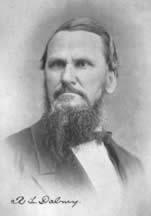
R. L. Dabney (1820–1898) on Meditation

I just finished reading the article Meditation A Means of Grace by R. L. Dabney. The church needs to read Dabney's theological writings. This was a brilliant and godly man.

The following excerpt from his article describes some of the reasons why I named my Blog as I did. Deep meditation on theological truths should spark excitement and love for God, our neighbor, and for all of creation. When our affections are touched by true theological meditation, then we are ready to be used of God and we will have the right motives. If the church is infected by the desire to meditate on the divine being in Spirit and in truth, then it will once again "turn the world upside down" (Acts 17:6).

Dabney said:
The strength derived from meditation has also been potent to bless. To this are due the evolutions of the greatest truths of philosophy and religious freedom which form the heritage of civilized man, as well as the noblest exploits of arms and policy. The authors of human progress have not been your self-styled "practical men," whose only notion of activity is change; whose only energy is restlessness; who see no end for truth save its immediate application to corporeal good. Let not these say that they can well resign to the man of meditation the shadowy glories of philosophy, since the arts are theirs which supply men's practical wants. They cannot even do this; even in their own poor, materialistic sense. But for the nobler dreamers, they could not have taught us to navigate ships, to spin calicoes, to compound drugs. Where would be your dexterous man of arts, your navigator, your chemist, your machinist, without the musings of a Kepler, a Bacon, a Newton? No; your merely practical man is not he who descends into the central caverns and primeval abysses of nature, to mine for us the golden ore of truth and right; he is but the trafficker, who circulates it from hand to hand, and who tarnishes and wastes it in his traffic.

The men who have changed the face of the world have been the reserved, the meditative; men of profound insight, wont to retire into the depths of their own consciousness; men who receive the beautiful and the good with a poet's intense appreciation, and hold them with unwavering grasp of mind and heart. See King David, warrior, conqueror, legislator, busy founder of a polity and dynasty; he, more than any other inspired author, delighted in holy musings, and satisfied his soul with midnight meditations, as with marrow and fatness. See the man from whose giant will proceeded, more than from that of any other man, that revolution of thought upon whose swelling tides we are still borne, after more than three centuries, whither, we know not. Luther burst upon Europe as teacher, preacher, critic, poet, musician, statesman, ecclesiastic, polemic, patriot and filled it with the din of his activity. It was amidst the musings of a convent and the reveries of his prison at Wartburg that the fires of this will were kindled. And this is what one should anticipate. Man feels as he sees, and acts as he feels. A great purpose is only formed when a great idea is kept in contact with the soul, by prolonged communion with it in the depths of its own conception. The mind which has basked long in the light of some quickening truth, like the tropic earth, bursts with the most vigorous and fruitful germs of purpose.

The habit of silent adoration is a fountain of happiness to the soul. "I will be glad in the Lord," saith the text. There is immediate pleasure in the sight of a material object of taste. We pause instinctively over a flower. We stand before a masterpiece of art, and crave leisure to enjoy it, deprecating analysis, criticism, and even converse, that the soul may silently imbibe the happiness of its perfection. When we look up, and see the moon walking in brightness, and the stars shooting their radiance from a stainless and unfathomable depth, we receive a spell of peaceful joy upon our hearts. But most happy are we when our meditations are charmed by the beauty of holiness and our eyes filled with the perfections of God; for there are the transcendent glory and symmetry to satisfy the intellect, the taste, and the conscience at once. What thought can be as sweet and grand as that of the Christian's God, infinite in being, in duration, in knowledge, in power, in holiness, directing his boundless kingdom with the calmness of infallible might, and yet with the beneficence of infinite love communicating himself as widely as his universe, and "opening his hand to satisfy the desire of every living thing," to creatures like us, tossed amid vanities, cares, and change? How full of calmness is the thought of a Being sufficient to himself, as unchangeably blessed as he is excellent? In this vision of God are merged our noblest conceptions of the stability of the spheres, the purity of the fields of azure, the duration of grandest cycles, the might of all elements, all creature beauty, all good, all power, all wisdom, all blessedness; all are in him, even as one drop is in the sea; and the more the soul expands towards the thought the more are we assured that everlasting intuition will never exhaust nor even comprehend its glories.
Robert L. Dabney, “Meditation A Means of Grace,” in Discussions, 5 vols. (Harrisonburg, Virginia: Sprinkle Publications, 1982), 1:649–51.

July 17, 2005

The Way to Study

He that studies only men, will get the body of knowledge without the soul; and he that studies only books, the soul without the body. He that to what he sees, adds observation, and to what he reads, reflection, is in the right road to knowledge, provided that in scrutinizing the hearts of others, he neglects not his own.
Colton, cited in The New Dictionary of Thoughts

NKJ Philippians 4:9 The things which you learned and received and heard and saw in me, these do, and the God of peace will be with you.

It would have been amazing to witness the lives of the prophets and Apostles, to look at them intently and meditate on their actions. This is what the Apostles did in watching Jesus. They "beheld his glory" and pondered his words. They observed how he treated people, and how each word was spoken with wisdom. The sound, volume, and nature of his words exactly fitted the needs of the situation. The majestic character of Christ came through in everything he did, and his followers gazed upon him in wonder and adoration.

NKJ John 1:14 And the Word became flesh and dwelt among us, and we beheld His glory, the glory as of the only begotten of the Father, full of grace and truth. (possibly my favorite verse)

If you see anyone like him, watch them. Think about what they are doing and saying. Study them. Be transformed by witnessing their lives. Treasure up their words in your heart as Mary did with Jesus' words. This is how to study.

July 10, 2005

Isaac Watts (1674–1748) on the The Improvement of the Mind

No man is obliged to learn and know every thing; this can neither be sought nor required, for it is utterly impossible: yet all persons are under some obligation to improve their own understanding; otherwise it will be a barren desert, or a forest overgrown with weeds and brambles. Universal ignorance or infinite errors will overspread the mind, which is utterly neglected, and lies without any cultivation.

Skill in the sciences is indeed the business and profession but of a small part of mankind; but there are many others placed in such an exalted rank in the world, as allows them much leisure and large opportunity to cultivate their reason, and to beautify and enrich their minds with various knowledge. Even the lower orders of men have particular callings in life, wherein they ought to acquire a just degree of skill; and this is not to be done well without thinking and reasoning about them.

The common duties and benefits of society, which belong to every man living, as we are social creatures, and even our native and necessary relations to a family, a neighbourhood, or a government, oblige all persons whatsoever to use their reasoning powers upon a thousand occasions; every hour of life calls for some regular exercise of our judgement as to times and things, persons and actions: without a prudent and discreet determination in matters before us, we shall be plunged into perpetual errors in our conduct. Now that which should always be practised, must at some time be learnt.

Besides, every son and daughter of Adam has a most important concern in the affairs of a life to come; and therefore it is a matter of the highest moment for every one to understand, to judge, and to reason rightly about the things of religion. It is in vain for any to say, We have no leisure or time for it. The daily intervals of time, and vacancies from necessary labour, together with the one day in seven in the Christian world, allow sufficient time for this, if men would but apply themselves to it with half as much zeal and diligence as they do to the trifles and amusements of this life, and it would turn to infinitely better account.

Thus it appears to be the necessary duty and the interest of every person living to improve his understanding, to inform his judgment, to treasure up useful knowledge, and to acquire the skill of good reasoning, as far as his station, capacity, and circumstances furnish him with proper means for it. Our mistakes in judgment may plunge us into much folly and guilt in practice. By acting without thought or reason, we dishonour the God that made us reasonable creatures, we often become injurious to our neighbours, kindred, or friends, and we bring sin and misery upon ourselves: for we are accountable to God, our judge, for every part of our irregular and mistaken conduct, where he hath given us sufficient advantages to guard against those mistakes.
Isaac Watts, The Improvement of the Mind (London, 1833; repr. Morgan, PA: Soli Deo Gloria Publications, 1998), 1–2.

June 27, 2005

The Dark Background

Update on 2-28-10: When this was originally posted, the background color of my blog was black.

Incidently, I decided on the dark background and white text because it symbolically represents illumination at night :-) I am a night owl and do most of my reading and thinking at night. I only hope it is not difficult for anyone's eyes.

NKJ Psalm 119:148 My eyes are awake through the night watches, That I may meditate on Your word.

I enjoy the quiet. Everyone is asleep and the noise is minimal. I recall a passage in C. S. Lewis' book The Screwtape Letters where one of the demons, Wormwood perhaps, sings for joy at the thought of all the chaotic noise. Can you imagine in the premodern days when the stars were out and the technological noises of today did not exist?! In the Dallas/Fort Worth area, there is ALOT of noise and light pollution. It tends to ruin opportunities for quiet meditation and reflection on God's greatness. Due to all the lights, one can't look up at the sky and marvel at all the stars bearing witness to God's glory. The noise and other distractions draw our attention away from transcendent ponderings, and bring our minds to the horizontal and secular. I do not mean to make a strong sacred/secular dichotomy here, but I trust that the reader gets my point. The transcendent is crowded out by noises and diversions. Thomas Morris remarks in his book Making Sense of it All:
How do people manage to ignore the deepest and most important questions of life and death? Why don’t people worry more about what this life, with all its problems, is all about? To these questions Pascal has an intriguing answer. People manage to put on the blinders, to avert their gaze from these ultimate issues, and to avoid facing their utter hopelessness by means of diversion.
I would encourage people to pick up Pascal's book Pensees and consider what he has to say about diversion. What I have said above is that there is a sense in which modernity, with all of it's glittering distractions, crowds out the transcendent by means of noises and lights. I find the night time to be best for me to engage in theological reflection. I guess that is also the case because I work in the evenings at UPS :-)

For an interesting read on diversion and the Christian life, go here:

June 26, 2005

More Meditations on Meditation

I decided to check other quotation books in my library for more quotes dealing with meditation. The following quotes are insightful:

"Meditation is the best beginning of prayer, and prayer is the best conclusion of meditation." - George Swinnock from A Puritan Golden Treasury

"The end of study is information, and the end of meditation is practice, or a work upon the affections. Study is like a winter sun, that shines, but warms not: but meditation is like a blowing upon the fire, where we do not mind the blaze, but the heat. The end of study is to hoard up truth; but of meditation to lay it forth in conference or holy conversation." - Thomas Manton from A Puritan Golden Treasury

"Singing God's praise is a work of the most meditation of any we perform in public. It keeps the heart longest upon the thing spoken. Prayer and hearing pass quick from one sentence to another; this sticks long upon it." - John Lightfoot from A Puritan Golden Treasury

"What is the reason there is so much preaching and so little practice? For want of meditation. . . . Constant thoughts are operative, and musing make the fire burn. Green wood is not kindled by a flash or spark, but by constant blowing." - Thomas Manton from A Puritan Golden Treasury

"There are two things that make meditation hard. The one is, because men are not used thereunto....and another is, because they do not love God enough. Everything is hard at the first: writing is hard at the first. There is nothing not hard to those that are unwilling. There is nothing hard to those that love, love makes all things easy. Is it a hard thing for a lover to think or meditate on the person loved?" - William Bridge from A Puritan Golden Treasury

"The sweet spices of divine works must be beaten to powder by meditation, and then laid up in the cabinet of our memories." - Abraham Wright from A Puritan Golden Treasury

"I will conclude with that excellent saying of Bernard: "Lord, I will never come away from Thee without Thee." Let this be a Christians resolution, not to leave off his meditations of God till he find something of God in him." - Thomas Manton from A Puritan Golden Treasury

"To believe a thing is to see the cool crystal water sparkling in the cup. But to meditate on it is to drink of it. Reading gathers the clusters; but contemplation squeezes forth their generous juice." - C. H. Spurgeon from Spurgeon At His Best

"I would to God that after every sermon all my hearers, young and old, had a quarter of an hour alone! A night of wakeful thought over it would be better still." - C. H. Spurgeon from Spurgeon At His Best
"Faith gathers the handfuls of sacred corn from which contemplation threshes out the ears and prepares soul-sustaining bread." - C. H. Spurgeon from Quoting Spurgeon

"Love to God will induce meditation. Neglect of meditation argues want of love." - C. H. Spurgeon from Quoting Spurgeon

"True fathers in grace meditate upon Christ; they feed upon Scripture, press the juice of it, and inwardly enjoy the flavor of it." - C. H. Spurgeon from Quoting Spurgeon

"Meditation and careful thought exercise us and strengthen the soul for the reception of the yet more lofty truths. . . .Our Lord wishes us to be good slingers, and he puts up some precious truth in a lofty place where we cannot get it down except by slinging at it; and, at last, we hit the mark and find food for our souls. Then have we the double benefit of learning the art of meditation and partaking of the sweet truth which it has brought within our reach. We must meditate, brothers. These grapes will yield no wine till we tread upon them. These olives must be put under the wheel, and pressed again and again, that the oil may flow therefrom." - C. H. Spurgeon from Quoting Spurgeon

June 25, 2005

A Meditation on Meditation and It's Importance

I thought I would begin blogging with reflections on the nature and importance of meditation. Some of the most pleasurable experiences in my Christian life have been those times when I reflected and meditated on God's thoughts. As the Psalmist said:

NKJ Psalm 139:17 How precious also are Your thoughts to me, O God! How great is the sum of them!

After gaining and discerning wisdom in Christ after my conversion, I am content to live a quiet life of contemplation and meditation on divine things. When I come to the end of my days, I only hope that I have lived a life of pleasurable divine meditation unto Christlikeness to the glory of the Father. This is the goal of my "Theological Meditations."

Here are some useful quotes:

"Meditation is a particular way of receiving the revealed and dynamic Word of God into the heart from the mind so as to direct the will in the way of God's guidance. It is related to, but not identical with, either intellectual study or prayer."—Peter Toon, From Mind to Heart

Meditation is "that ordinance of Christ, and obedience or duty of a Christian, whereby he acts his spirit into a right pondering of either heavenly and spiritual things, or any other things, in a holy manner, unto spiritual and holy ends and improvements only."—Nathanael Ranew's Solitude Improved by Divine Meditation

"Sometimes the most blessed God himself is the high subject of his meditating; and what transcendencies of thoughts, what raptures, what instances of highest soul transportings hath he this way recorded for us, purposely to put us upon pursuit of the like glimpses and tastes, by suitable first breathings and pantings after sweetest communion with him!"—Nathanael Ranew's Solitude Improved by Divine Meditation

"By meditation I can converse with God, solace myself on the bosom of the Savior, bathe myself in the rivers of divine pleasure, tread the paths of my rest, and view the mansions of eternity."—Anon., in The New Dictionary of Thoughts

"No soul can preserve the bloom and delicacy of its existence without lonely musings and silent prayer, and the greatness of this necessity is in proportion to the greatness of evil."—Farrar, in The New Dictionary of Thoughts

"It is not hasty reading, but seriously meditating upon holy and heavenly truths that makes them prove sweet and profitable to the soul. It is not the bee's touching on the flowers that gathers the honey, but her abiding for a time upon them, and drawing out the sweet. It is not he that reads most, but he that meditates most on divine truth, that will prove the choicest, wisest, strongest Christian." —Joseph Hall, in The New Dictionary of Thoughts

"It is not the number of books you read, nor the variety of sermons you hear, nor the amount of religious conversation in which you mix, but it is the frequency and earnestness with which you meditate on these things till the truth in them becomes your own and part of your being, that ensures your growth."—F. W. Robertson, in The New Dictionary of Thoughts

"Meditation is that exercise of the mind by which it recalls a known truth, as some kind of creatures do their food, to be ruminated upon till all the valuable parts be extracted."—George Horne, in The New Dictionary of Thoughts