November 25, 2006

R. C. Sproul (1939–2017) on Statism

Relativism Ultimately Results in Statism

Pluralism and relativism have no possibility of being true because, from the beginning, the very possibility of truth itself is eliminated. If everything is true, then nothing is true. The word truth is now empty of meaning. That is why modern man finds himself in a dilemma. He is thrown into chaos long-term, and man cannot continually live in intellectual chaos. There is a sense in which our present culture, more often than in any other period in history, is “up for grabs.” When this emptiness has happened in the past, something has come to fill that vacuum. Relativism is ultimately intolerable. What will come to this vacuum is some form of statism because something has to bring unity. The good of the “state” will become the ultimate point of unity.

I saw this picture on the Drudge Report after the last elections. This Sproul quote immediately came to mind.The rapid growth of the centralized state is happening before our eyes in the United States. Consider the areas where people of America formerly looked to God for their security, their meaning, and their decision making and now, instead, they look to the state. This eventually becomes statism, where the state becomes the goal of life. The state becomes the reason for us to live. The state unifies, transcends, becomes absolute, and is eternal.

The state steps in and says we are going to be united. How? By going to the same schools, by learning the same things, by saying the same words. At the extreme, look at the nation of China, a uniformity by enforced unity. We may say that is the very opposite of pluralism. No, that is the result of pluralism. That is the result of the loss of transcendent unity. The God whom we worship is a God who brings unity, but at the same time preserves diversity. We all have a sinful tendency to force everybody else to conform to us. Even in the church we see this tendency. I am a teacher and I want to exalt teaching as the only significant gift of the Holy Spirit. You’re an evangelist and you have no time for the teacher. Yet God has said one body, one Lord, one faith, one baptism – but a diversity of gifts and talents, a diversity of personality. Your humanness is beautiful in the intricacies of its diversity, but your humanness also finds an ultimate point of reference in the character of God. Take away that ultimate reference point and humanity itself is demeaned.

We cannot live on this side of the wall alone. We are going to either have God on the other side of that wall or we will substitute the state in His place. I challenge you to find one culture in the world where that has not happened. That’s what terrifies me.

The American government faces a serious crisis. People are demanding from the state more than the state can give. People are looking to the state for salvation. Unfortunately, the state does not have the equipment to save a fallen race. The state exists on this side of the wall. It can never provide ultimate unity for our plurality unless it becomes absolute. Relativism provides a moral vacuum that screams to be filled. As nature abhors a vacuum, totalitarian governments love one. They rush in to fill a vacuum.
R. C. Sproul, Lifeviews: Make a Christian Impact on Culture and Society (Old Tappan, NJ: Fleming H. Revell, 1986), 126–127.

I also remember the following story being conveyed on the radio by either R. C. Sproul sr. or his son. Sproul jr. said:
My father tells a story about sharing a cab ride to the airport with the late Dr Schaeffer after they had spoken together at a conference and my dad, not wishing to miss the opportuninty, asked Dr Schaeffer: “What is it that you are most worried about for the church in the future?”

And without hesitation Dr Schaeffer said, “Statism”. Now when we think Stateism, our tendency is to think, high taxes. Our tendency is to think strictly in terms of day-to-day headaches that come from the State. But Stateism as an ‘-ism’ is so much broader than that. It communicates the view of the State as god. The metaphor of the state determines reality, the state determines morality, the state determines teleology, the state determines everything. And that works itself out in ways that don’t look like Stateism, but really are...
Peter Toon on the Divine Art of Meditation

St. Thomas' Episcopal Church has three sermon series available online by Dr. Peter Toon. Here are the files for the series on The Divine Art of Meditation:

Peter Toon: The Divine Art of Meditation: 1 of 4 (8/7/2005)

Peter Toon: The Divine Art of Meditation: 2 of 4 (8/14/2005)

Peter Toon: The Divine Art of Meditation: 3 of 4 (8/20/2005)

Peter Toon: The Divine Art of Meditation: 4 of 4 (8/27/2005)

Other messages available:

HEAVEN, already but not yet:
Sermon 1. "We shall rest"
Sermon 2. “We shall see.”
Sermon 3. "We Shall Love"
Sermon 4. "We Shall Praise"

Fear & Love, inseparable twins (also in 4 parts)

Toon's written material on meditation can also be found HERE.

November 22, 2006

Gratitude, God's Revealed Will and a Prayer

Give thanks with a grateful heart,
Give thanks to the Holy One,
Give thanks because He's given
Jesus Christ His Son
.

This Thanksgiving I will be with my mom, my brother and his family who live nearby. They have not yet trusted Christ. However, I am glad I can come to them with the good news of the gospel and freely tell them that God gave his Son to die to save them. I can honestly look them in the eye and tell them that God is good to all because he wishes to save all, therefore he grants food, rain, sunshine, a free society and clothes etc. with a view to stimulating them to repentance (see Rom. 2:4). This is the point of common grace and all mankind receives this grace, to one degree or another. Everyone is enjoying these common bounties of providence because of God's benevolent will (Matt. 5:45).

Instead of merely looking at the world through the secret will of God this Thanksgiving (and how Christ came to especially save you as one of the elect), try looking at it through God's revealed will as well, and think about what the death of Christ means for all mankind, particularly for those lost family members that you love and desire to be saved. If you desire them to be saved, it's because the Holy Spirit is at work in you to desire such a thing. It's not as if your will to see them saved is out of harmony with God's will, as if you merely desire such a thing because you're ignorant about who is elect and who is not. Christ, as the Godman, wished the same thing for his lost family members.

Since my family knows that I am a student of theology, they may ask me to pray before the meal, as if I am to function as a kind of family priest (we were raised Roman Catholic). If I am asked to pray, I suppose I will say something like this:
Heavenly Father, Your Son taught us to first hallow your name when we pray. I am grateful that you are holy, just and good. You are also patient and full of generosity, so much so that you gave your only begotten Son to die for the salvation of the whole human race. I thank you for bringing my heart to know that fact and to trust in him. May you do this for those I love as well. May we all give thanks for your constant generosity this Thanksgiving in such a way that we come to your Son for forgiveness and healing, for it is in Him that you accept our prayers and thanks. Amen.
Now that's a Calvinistic prayer! :-) More importantly, it's a biblical prayer.

November 7, 2006

Ulrich Zwingli (1484–1531) on Christ's Death

If then Christ by his death has reconciled all people who are on earth when he poured out his blood on the cross and if we are on earth, then our sins, too, and those of everyone who has ever lived, have been recompensed by the one death and offering.
Zwingli, Exposition and Basis of the Conclusions or Articles Published by Huldrych Zwingli, 29 January 1523, Pickwick Publications, vol. 1, p. 97.

Bio:
Wiki

Hans Boersma on Richard Baxter (1615–1691) and Moïse Amyraut (1596–1664)

The view of Baxter as an Amyraldian theologian needs some modification, especially in light of the view that he did not derive his position on the extent of the atonement from Moyse Amyraut. When, in his Parænesis ad ædificatores Imperii in Imperio (1656), Lewis Du Moulin denounces Amyraut's theology, he comments that "in England only one Baxter is exceedingly pleased with his method." Baxter denies being a proselyte of Amyraut, saying that "this unus Baxterus did write a Book for Universal Redemption in this middle sens[e], before ever hee saw either Amyraldus, Davenant, or any Writer (except Dr Twisse) for that way ..."

Yet, Baxter is not adverse to the views of John Cameron and Amyraut on redemption. On the contrary, when John Tombes reproaches Baxter for his view on universal redemption, Baxter replies: "And to tel[l] you freely my thoughts, that is the point of universal Redemption wherein I think Amyrald doth best, and in that ... I approve of most he saith." What is more, when Baxter distinguishes the absolute promise of the first grace for the elect and the legal moral donation for all, he specifically appeals to Cameron, Amyraut, Davenant, Samuel Ward, and the Canons of Dort for support. Thus, while it does not appear that Amyraut had an immediate impact on Baxter's views on the extent of the atonement, there is an obvious congeniality between the two authors.
Hans Boersma, A Hot Pepper Corn: Richard Baxter's Doctrine of Justification in Its Seventeenth-Century Context of Controversy (Vancouver, BC: Regent, 2004), 197–198.

Brian Armstrong on Amyraut and Justification

Amyraut defines justification in the same terms as did Calvin. That is, justification consists of two parts: “. . . the remission of sins and the imputation of the righteousness of Christ.” It is forensic in nature, for we are accounted righteous for the sake of Christ: “We maintain that when God will give us life and the Kingdom, He will not consider any other merit nor any other obedience than that of His Son whom we embrace by faith.” Moreover, this manner of justification is in opposition to our natural inclination, for all men believe that they will be justified by their own merit, by their own works. For this reason in this matter man must, according to one of Amyraut’s favorite passages, bring into captivity every thought to the obedience of Christ and recognize that “justification by faith is by a totally supernatural revelation and institution, for there is nothing less in accord with the institutions of nature than to justify a guilty man by imputing to him the sufferings of another who has been punished for him.
Brian Armstrong, Calvinism and the Amyraut Heresy: Protestant Scholasticism and Humanism in Seventeenth-Century France (Eugene, OR: Wipf & Stock Publishers, 2004), 225.

Notice the substitutionary language when Amyraut says, "imputing to him the sufferings of another who has been punished for him." Also, as Armstrong points out in the rest of Chapter 5, Amyraut made a very crucial distinction between the covenants of law and grace in his system. Whoever associates Amyraut with Baxter's neonomianism betrays a profound ignorance of Amyraut's covenantal scheme and how vital it is to his view of justification by grace alone through faith alone in Christ alone.

November 6, 2006

Amyraut and Ordered Decretalism

Here’s what Brian Armstrong says about Amyraut and lapsarian speculations:
One of Amyraut’s favorite criticisms of orthodox theologians was of their metaphysical speculations, which he apparently felt resulted from their methodology. He was fond of emphasizing Calvin’s principle that God’s essence is incomprehensible for rational man, that “Men who . . . resolve to seek out what God is are but merely amusing themselves with insipid speculation.” In particular, Calvin cautioned that this principle must be applied in any consideration of the decree of election; it can be a source of consolation only if man begins with faith rather than the counsel of God. He says:
The election of God will be a fatal labyrinth for anyone who does not follow the clear road of faith. Thus, so that we may be confident of remission of sins, so that our consciences may rest in full confidence of eternal life, so that we may boldly call God our Father, under no circumstances must we begin by asking what God decreed concerning us before the world began. Rather we must begin by seeking what through His paternal love He has revealed to us through the Gospel. We must seek nothing more profound than that we become the sons of God.
Amyraut considered the orthodox doctrine of predestination, with all its speculation about the order of God’s decrees, an outright denial of this principle, and constantly called on Calvin in his desire to correct this orthodox tendency. Concerning the ordering of the decrees he makes the following incisive judgment:
... I am well aware that Calvin has said many things relating to the "impulsive" causes of the decrees of God, but as to their order I do not see that he has ever said a word. Why God has created man for hope of perpetual blessedness, he states that the only reason for this is His goodness. Why, man having fallen into sin and condemnation, God willed to send His son into the world to redeem men by His death, Calvin states that the only reason for this is an admirable love of God for mankind. Why He has elected some and passed by others in imparting the grace of faith, Calvin states that the only reason for this is the mercy and severity of God. Why God has preferred one individual to another in the distribution of this grace, Calvin does not recognize any other reason than solely the perfectly free will of God. Why He has willed to save believers and to condemn unbelievers unto eternal punishment, Calvin has thought that the reason for the latter must be taken from the justice of God whereas the reason for the former must be taken from His mercy...But what has been the order according to which God has arranged all these things in His eternal wisdom, when it is a question of His having proposed of thinking or willing what comes first or last, Calvin has never explained this nor has he the least interest in doing so.
Amyraut goes on to say that this order in the decrees is a matter in which the "secrets are so profound, and the abyss so impossible to explore, that whoever will undertake to know them would necessarily be swallowed up by them or will necessarily remain eternally deluded as being in a completely inexplicable labyrinth." Nor, he continues, has the Spirit of God furnished and light on this matter in the Word.
Brian Armstrong, Calvinism and the Amyraut Heresy (Eugene, OR: Wipf and Stock Publishers, 2004), 162–164.

John Quick reports what the Amyraldian party said before a French Synod (probably Alencon) this way:
2) As to making distinct decrees in the council of God, the first of which is to save all men, through Jesus Christ, if they shall believe in him, the second to give faith unto some particular persons, Amyraut, along with Testard, declared, that they did this upon no other account than of accommodating it unto that manner and order which the spirit of man observeth in his reasonings for the succour of his own infirmity; they otherwise believing, that though they considered this decree as diverse, yet it was formed in God in one and the self-same moment, without any succession of thought or order of priority and posteriority.
John Quick, Synodicon in Gallia Reformata (London: Printed for T. Parkhurst and J. Robinson, 1692), 2:355.

If one wants to understand what Amyraut said about the decrees and their ordering, don't consult unreliable secondary sources that perpetuate a mythological Amyraut instead of the authentic Amyraut. Since there is only one of his works translated into english (his Brief Treatise on Predestination translated by Richard Lum in 1985 in partial fulfillment of his doctoral degree at Dallas Theological Seminary), he is severely misunderstood and misrepresented. If one wishes to research the man and his thought, consult those that have dealt with the primary sources and cite them carefully.

Incidentally, R. L. Dabney and Herman Bavinck are other examples of Reformed men who have been critical of the tendency to speculate about the order of the decrees. Both of them rejected lapsarianism.

See the following posts for more about Amyraut's views:

Nicole Quoting Quick

Paul Testard's Dualism

These two posts should help to dispel the myth that Amyraut argued that Christ died for all equally, without any qualifications. Too many are eager to erect this straw man in their arguments. On the contrary, Amyaut taught that the death of Christ was equally for all, but that Christ died unequally for all. In other words, there is no limitation in the death itself or the imputation of sin to Christ (it's equally sufficient to save all sinners), but there is a limit in Christ's intentions in suffering such an all-sufficient death. He wholeheartedly affirmed the classic understanding of Christ suffering sufficiently for all (the general intent), but especially for the elect (which is the special intent).

If someone wants to call you an "Amyraldian" for holding a dualistic view, ask them why they are not calling you a "Calvinist." After all, Amyraut was echoing Calvin's views regarding Christ's satisfaction. Here's the dirty little secret: They are calling you an "Amyraldian" because they aren't even interpreting Calvin correctly and they want to alienate you from Reformed/Calvinistic circles. Instead of engaging Calvin's own categories as presented in the primary sources, they just tell you to consult their "experts." When someone calls me an Amyraldian, I just say "I am an Amyraldian in so far as he agrees with Calvin." :-) Or, I could say, "I am an Amyraldian in so far as he agrees with Calvin, Musculus, Bullinger, Zwingli, Ursinus, Ussher, Cameron, Davenant, Polhill, Baxter, Martinius, Calamy, Vines, Seaman, Arrowsmith, Preston, Watts, Marshall, Howe, Bunyan, Ryle, Dabney, Shedd, C. Hodge, Kuiper..." and on and on it goes. I might also add EVERY OTHER CHRISTIAN THAT LIVED PRIOR TO BEZA, with the exception of Gottschalk.

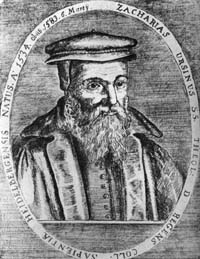
The Heidelberg Catechism and Zacharias Ursinus (1534–1583) on Christ's Death and the Will of God

The Heidelberg Catechism on Question 37 says:
37. Q. What do you confess when you say that He suffered?

A. During all the time He lived on earth, but especially at the end, Christ bore in body and soul the wrath of God against the sin of the whole human race. Thus, by His suffering, as the only atoning sacrifice, He has redeemed our body and soul from everlasting damnation, and obtained for us the grace of God, righteousness, and eternal life.

Zacharias Ursinus (1534–1583), in his commentary on the Heidelberg Catechism, said:
Question: “If Christ made a satisfaction for all, then all ought to be saved. But all are not saved. Therefore he did not make a perfect satisfaction.”

Answer: “Christ satisfied for all, as it respects the sufficiency of the satisfaction which he hath made, but not as it respects the application thereof.” (HC commentary, p. 215.)


Here are a few more quotes from Ursinus:
God willeth that all be saved, as he is delighted with the salvation of all...[and] inasmuch as he inviteth all to repentance: but he will not have all saved, in respect of the force and efficacy of calling. Ursinus, The Summe, p. 353.
Quoted in G. Michael Thomas, The Extent of the Atonement: A Dilemma for Reformed Theology from Calvin to the Consensus (1536–1675) (Carlisle: Paternoster, 1997), 110.
He satisfied for all regarding satisfaction, but not with respect to application. The Summe, pp. 131–132.
Thomas, The Extent of the Atonement, 111.
The cause why all are not saved by Christ, is not the insufficiency of the merit and grace of Christ (for Christ is the full propitiatory sacrifice for the sinnes of the whole world, as concerning the worth and sufficiency of the ransome and price which he paid) but it is the infidelity of men, whereby they refuse the benefits of Christ offered in the Gospel...
Thomas, The Extent of the Atonement, 111.
Christ was ordained by God the Father...to offer himself a sacrifice propitiatory for the sins of all mankinde...and lastly to apply effectually his sacrifice unto us...by enlightening and moving the elect. The Summe, pp. 116–117.
Thomas, The Extent of the Atonement, 111.

Thomas comments on Ursinus:
Ursinus' double-sided doctrine of the extent of the atonement resembles Bullinger's position, as does his use of the conditional covenant theme. It also bears a strong resemblance to that of the Bernese theologian Wolfgang Musculus (1497–1563).
Thomas, The Extent of the Atonement, 112.